
- Sep 24, 2025
- Hits: 391
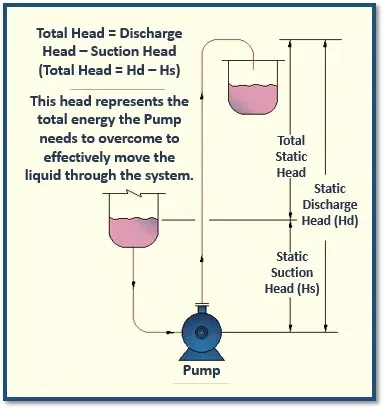
The term “total head” (H) is used to describe the energy in pumping systems and is how manufacturers represent the performance of their pumps as a function of flow rate. Total head is also commonly referred to as total dynamic head (TDH); however, the Hydraulic Institute (HI) uses the term total head and it will be used throughout this article.
The head is a measure of the height a pump can raise a fluid, usually expressed in meters (m) or feet (ft). It represents the energy imparted to the fluid by the pump, measured as the height of the fluid column it can lift.
Head does not depend on the type or density of the fluid but rather the amount of energy per unit weight that the pump can supply to the fluid.
There are several components that make up the total head in a pump system:
The vertical distance between the fluid level at the pump's suction (inlet) and the discharge point. It's the energy required to lift the fluid.
The height of the fluid above the pump's inlet. When the fluid source is below the pump, it’s called suction lift.
The height from the pump’s discharge to the point of fluid delivery.
The head loss due to friction as the fluid moves through pipes, fittings, and valves. Longer pipes, bends, and smaller diameters increase friction head.
The energy required to impart velocity to the fluid. It is typically small compared to static and friction head, especially in low-velocity systems.
The sum of all the head components a pump must overcome to move fluid through a system. It is calculated as: TDH=Hₛ+Hᶠ+Hᵥ