A high temperature magnetic drive pump for 300–350 °C liquids has to do three things the liquid makes difficult. It must keep its magnets cooler than the liquid, keep its internal bearings wet, and keep its pressure boundary within rating at temperature. Shinjo's CQB-G is rated for liquids up to 300 °C and the MT-HTP for liquids up to 350 °C. Both cover 3.2–100 m³/h in stainless steel. Choose the rating from the hottest temperature the pump can see, then check NPSH, cold-start torque, cooling and warm-up. If a small seal leak is acceptable on hot thermal oil, a sealed hot oil pump is the simpler alternative.
| CQB-G | MT-HTP | |
|---|---|---|
| Maximum liquid temperature | 300 °C | 350 °C |
| Flow | 3.2–100 m³/h | 3.2–100 m³/h |
| Head | 20–80 m | 15–80 m |
| Sizes | DN32–DN100 | DN32–DN100 |
| Casing material | Stainless steel 304, 316, 316L | Stainless steel 304, 316, 316L |
| Cooling design | Multiple internal circulation paths, cooling vanes on the outer magnet rotor, pin coupling to the motor | External circulation cooling system |
| Motor range | 1.5–55 kW | 1.1–55 kW |
Choose the rating from the highest temperature the pump can reach, including upsets, not from the normal operating temperature. If the liquid normally runs at 290 °C but can reach 320 °C when a control loop fails, the duty needs the MT-HTP. Never assume a 300 °C pump will survive "short" excursions above its rating. The parts that set the limit, the magnets, bearings and gaskets, do not recover when the temperature falls.
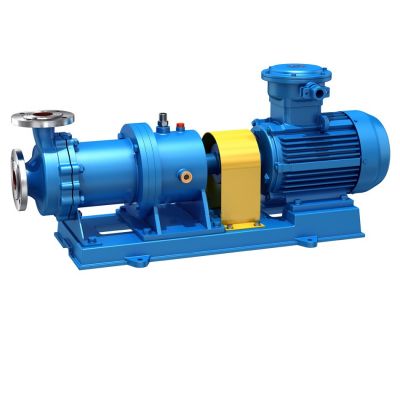
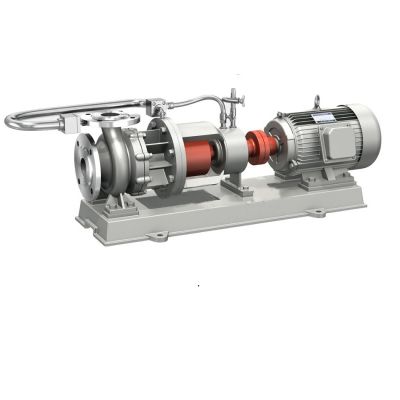
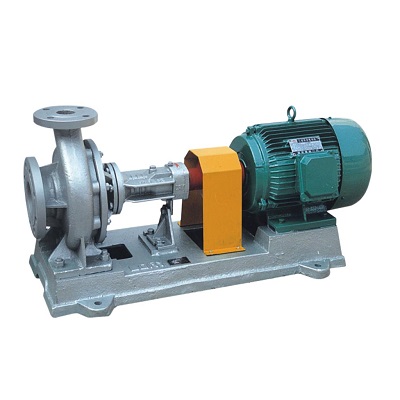
The liquid temperature and the magnet temperature are not the same thing, and the magnets usually set the real limit. Typical operating ranges are 150–220 °C for high-temperature neodymium magnets and 250–350 °C for samarium-cobalt magnets. A coupling that pumps a 350 °C liquid therefore has to keep its magnets well below the liquid temperature.
Heat reaches the magnets in three ways: by conduction through the casing, from the liquid circulating inside the pump, and from eddy currents in the metal containment shell, which add heat of their own. Overheated magnets lose torque. Above their limit, the loss becomes permanent, and the coupling slips under load.
That is why the cooling design matters as much as the temperature rating. On the CQB-G, cooling vanes on the outer magnet rotor and several internal circulation paths carry heat away from the magnets. The MT-HTP uses an external circulation cooling system. In both cases, the cooling only works if air can reach the bearing frame and coupling housing. Do not cover them with insulation, even if the rest of the pump is insulated.
Vapor pressure rises steeply with temperature. Some heat transfer fluids are used above their atmospheric boiling point. For example, the common diphenyl/diphenyl oxide fluids boil at about 257 °C at atmospheric pressure. At 300 °C or more, such a system must be pressurized, usually through the expansion tank, or the liquid flashes at the pump suction.
Calculate NPSH available at the highest temperature and the lowest system pressure, using absolute pressures and the vapor pressure of the actual fluid. Compare it with the pump's NPSH required: 3.2–4.5 m across the CQB-G range. Then leave margin. A magnetic drive pump also needs liquid to stay liquid inside the pump, in the passages around the shell and bearings, where the eddy-current heat raises its temperature further. If it flashes there, the bearings run dry even though the pump still delivers flow.
Thermal oils are many times more viscous cold than hot. At start-up the pump has to turn a thick liquid, so the torque demand can be far higher than at operating temperature. If the magnetic coupling is sized only for hot duty, it slips at a cold start. A slipping coupling heats its own magnets and can damage them before the system ever reaches temperature.
Give the supplier the viscosity at the coldest start-up temperature as well as at operating temperature. The motor and the coupling must both handle the cold case. Alternatively, preheat the loop, or start at reduced speed through a variable-frequency drive until the oil thins.
Hot liquid hitting a cold pump, or cold liquid hitting a hot one, causes uneven expansion. The containment shell, the close-clearance silicon carbide bearings and the casing gaskets suffer most. Bring the pump up to temperature with the system, and do not flush a hot pump with cold liquid.
Metals lose strength when hot, so the allowable pressure of flanges, casings and containment shells falls as temperature rises. A Class 150 flange holds roughly half as much pressure at 300 °C as at ambient temperature. Work out the highest discharge pressure, which is suction pressure plus the pump's shut-off head, and check it against the casing and shell rating at the maximum temperature, not at 20 °C.
Piping loads also grow with temperature. Thermal expansion of the connected pipework can push the pump out of alignment or overload its nozzles. Support the pipes independently, and do not pull them into place with the flange bolts.
- Never exceed the rated temperature, not even briefly. Magnet damage above the limit does not reverse.
- Never run dry or against a closed valve. The bearings and the shell overheat within minutes.
- Do not insulate the bearing frame or coupling housing. They need air to shed heat.
- No cold start on thick oil unless the coupling is sized for it. Preheat, or start slowly.
- No thermal shock. Warm up and cool down with the system.
A magnetic drive pump is the right choice when no leakage is acceptable, as with toxic, flammable or valuable hot liquids. For hot thermal oil in a heating loop, where a small weep from a seal is acceptable and larger flows are needed, the LQRY thermal oil pump is simpler and covers a wider range.
| CQB-G / MT-HTP magnetic drive | LQRY thermal oil pump | |
|---|---|---|
| Maximum liquid temperature | 300 °C / 350 °C | 350 °C |
| Shaft sealing | None (sealless) | Shaft seal ring, mechanical seal or carbon seal |
| Flow | 3.2–100 m³/h | 4.5–400 m³/h |
| Maximum head | 80 m | 85 m |
| Casing | Stainless steel | Cast steel |
| Best for | Toxic, flammable or valuable hot liquids | Thermal oil heating loops and larger flows |
Both need a clean liquid. Aged thermal oil carries carbon and sludge, which wear the bearings of a magnetic drive pump. Filter the loop, and replace degraded oil before it damages the pump.
- The liquid, its grade, and its vapor pressure and viscosity at both start-up and operating temperature.
- Normal temperature, maximum temperature, and how long any upset lasts.
- Flow, head and system pressure, including how the system is pressurized.
- NPSH available at the hottest condition.
- Ambient temperature and the cooling utilities available.
- Start-up procedure, including whether the loop is preheated.
- Hazardous-area classification.
Pumping a hot liquid above 200 °C? Send the details to SHINJO and we will confirm the right high temperature model and coupling for your duty. See the full range of magnetic drive pumps, or read how to select a magnetic drive pump.
No. Magnets, bearings and gaskets can be damaged permanently above their rating, even briefly. If the liquid can reach 350 °C in any operating state, specify a pump rated for 350 °C, such as the MT-HTP.
Samarium-cobalt magnets are typically used at high temperature because they work at about 250–350 °C. Neodymium magnets are stronger but typically limited to about 150–220 °C even in high-temperature grades. The cooling design must still keep the magnets below the liquid temperature.
It depends on the design. The CQB-G cools itself through internal circulation paths and cooling vanes on the outer magnet rotor. The MT-HTP uses an external circulation cooling system. Ask which utilities the quoted model requires and what happens if they fail.
Yes, if the oil is clean and the pump is rated for its maximum temperature. Check NPSH at the hottest condition and size the coupling for cold-start viscosity. For large heating loops where a small seal leak is acceptable, a sealed thermal oil pump is often the simpler choice.
Usually because the oil is too viscous when cold and the coupling torque is too low for that condition. Preheat the loop, start at reduced speed, or ask for a stronger coupling. Do not keep restarting a slipping pump, because each slip heats the magnets.
