A magnetic drive pump and a canned motor pump both remove the shaft seal, the most common leak path in a centrifugal pump. The difference is how they drive the impeller. A magnetic drive pump uses a standard motor and turns the impeller through a magnetic coupling, across a sealed containment shell. A canned motor pump puts the motor rotor inside the liquid, behind a thin can that protects the stator windings. For most chemical transfer, a magnetic drive pump is easier to own because the motor is standard and the pump can be repaired on site. A canned motor pump is more compact and suits clean liquids in closed loops, but it usually needs specialist repair.
Magnetic drive pump. An outer magnet rotor sits on the motor shaft. An inner magnet rotor is fixed to the impeller shaft. Between them is a stationary containment shell, also called an isolation sleeve, that closes off the liquid completely. The magnetic field passes through the shell and turns the impeller without any contact, so no shaft passes through the pressure boundary. The impeller runs on sleeve bearings lubricated by the pumped liquid.
Canned motor pump. The pump and motor form one sealed unit on a common shaft. The motor rotor turns in the pumped liquid, and a thin corrosion-resistant liner, the "can", separates the liquid from the stator windings. Some of the liquid circulates through the motor to cool it and to lubricate the sleeve bearings. There is no coupling and no separate motor.
Both are sealless designs. Static joints such as casing gaskets and flanges remain, so "zero leakage" means no leakage at the shaft, not that the installation can never leak.
| Magnetic drive pump | Canned motor pump | |
|---|---|---|
| Motor | Standard motor, including off-the-shelf explosion-proof versions | Special motor built into the pump |
| Pressure barrier | Stationary containment shell | Stator can; in many designs the motor housing is a second barrier |
| Heat added to the liquid | Eddy-current heat from a metal shell; almost none from a plastic or ceramic shell | Motor and can losses heat the liquid circulating through the motor |
| Bearing monitoring | Recommended | Essential: worn bearings let the rotor touch the can and damage the windings |
| Repair | Motor swapped on site; wet end usually repaired on site | Usually returned to the manufacturer or an approved shop |
| Footprint | Longer, because of the separate motor | Compact, with no coupling; can be mounted in the pipeline |
| Changing the duty | Impeller or coupling can often be changed | Tied more closely to the original design duty |
| Standard | API 685 covers both sealless designs | API 685 covers both sealless designs |
A metal containment shell sits in a rotating magnetic field, so eddy currents flow in it and turn into heat. That heat is carried away by the liquid flowing through the inside of the pump. Ceramic shell suppliers report that switching from a metal shell to a non-conductive one cuts power input by 10–15%. That figure gives an idea of the loss in a metal shell. Hastelloy is a common metal choice because its low electrical conductivity keeps the loss down.
The heat matters most for liquids close to their boiling point. As an example, take a 15 kW pump on toluene. Here 10–15% is 1.5–2.3 kW. If only 1 m³/h of liquid circulates past the shell and bearings, the liquid there warms by about 4–5.5 °C:
ΔT = P ÷ (ṁ × cp) = 1.5 kW ÷ (0.24 kg/s × 1.7 kJ/kg·K) ≈ 3.7 °C
If that pushes the liquid above its boiling point at the local pressure, it flashes to vapor in the bearing passages and the bearings run dry. A canned motor pump has the same problem with motor heat. For volatile liquids, ask the supplier for the temperature rise in the internal circulation and the margin above vapor pressure.
Both designs depend on the pumped liquid to lubricate and cool their bearings. That gives them the same three weaknesses.
- Dry running. Without liquid, the bearings overheat in minutes. A magnetic drive pump also loses cooling at the shell, and overheated magnets lose strength.
- Solids. Abrasive particles wear the bearings and can block the small internal circulation passages. Sealless pumps need clean liquids.
- Gas. Entrained gas or vapor breaks the liquid film in the bearings.
The best protection is a motor power monitor, which detects dry running, a closed valve and a decoupled magnetic drive. A temperature sensor at the containment shell and a low-level or flow switch add further protection.
- Never run dry, not even for a short test. Fill and vent the casing before starting.
- Never run against a closed discharge valve. The trapped liquid heats up quickly.
- Keep above minimum flow so the internal circulation can carry the heat away.
- Keep solids out. Fit a suction strainer where particles are possible, and keep it clean.
Shinjo builds both types, but they serve different jobs.
| Pump | Type | Wetted material | Flow | Head | Liquid temperature |
|---|---|---|---|---|---|
| CQ | Magnetic drive | Stainless steel 304, 316, 316L | Up to 60 m³/h | 5–50 m | Up to 80 °C, 200 °C on request |
| CQB-F | Magnetic drive | Fluoroplastic lining | 1.8–100 m³/h | 8–32 m | Up to 80 °C |
| CQF | Magnetic drive | Polypropylene | 1–25 m³/h | 3–32 m | Up to 60 °C |
| ZCQ | Self-priming magnetic drive | Stainless steel 304, 316, 316L | 3–60 m³/h | 12–50 m | Up to 80 °C |
| ZBF | Self-priming magnetic drive | Polypropylene | 6.5–12.5 m³/h | 10–32 m | Up to 80 °C |
| CQB-G and MT-HTP | High-temperature magnetic drive | Stainless steel 304, 316, 316L | 3.2–100 m³/h | 15–80 m | Up to 300 °C and 350 °C |
| PBG | Canned motor | Cast iron | 6.3–1080 m³/h | 12.5–125 m | Up to 90 °C, clean water |
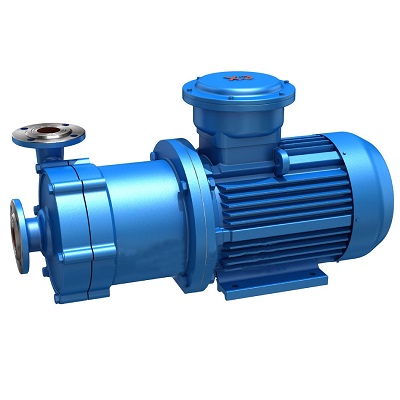
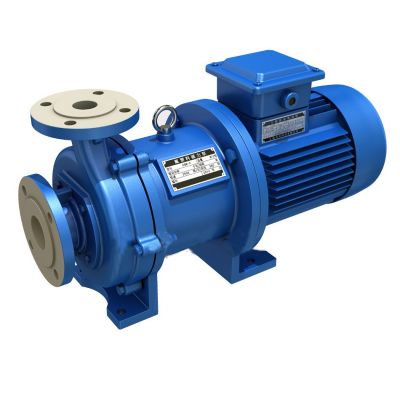
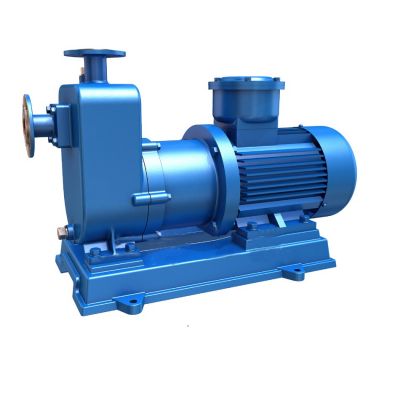
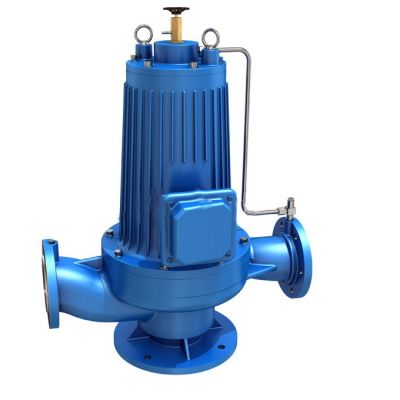
The PBG canned motor pump is designed for clean water: HVAC circulation, booster sets, fire pressurization and hot and cold water loops. It mounts directly in a horizontal or vertical pipe. Because it never draws in air, it also suits vacuum systems. For corrosive, toxic or flammable chemicals, Shinjo supplies magnetic drive pumps, with the wetted material matched to the liquid.
Choose a magnetic drive pump when:
- You want a standard or explosion-proof motor that your site can replace.
- Maintenance will be done on site.
- The liquid needs a lined or plastic wet end, such as acids and chlorides.
- The duty may change later.
- The pump must lift from below, which the self-priming ZCQ and ZBF can do.
Choose a canned motor pump when:
- The liquid is clean water or a similar clean liquid in a closed loop.
- Space is tight or the pump has to sit in the pipeline.
- Low noise matters, as in buildings.
Choose neither when the liquid carries solids, the pump may run dry often, or the viscosity is high. In those cases, a sealed pump with a double mechanical seal or an air-operated diaphragm pump is more reliable. For sizing details on magnetic drive pumps, see how to select a magnetic drive pump.
- The liquid, its concentration, density, viscosity and vapor pressure at operating temperature.
- Normal and maximum temperature.
- Flow, head and suction conditions, including whether the pump must self-prime.
- Solids content, if any.
- Hazardous-area classification and the motor protection required.
- Whether secondary containment or leak detection is required.
Comparing sealless options for a chemical duty? Send the details to SHINJO and we will recommend a magnetic drive pump with the right material and coupling. See the full range of magnetic drive pumps.
It depends on the design. A metal containment shell can cost around 10–15% of input power in eddy-current losses, while a plastic or ceramic shell avoids most of that. Canned motors lose power in the can and the motor. Compare the absorbed power each supplier quotes at your duty point.
No. Both rely on the pumped liquid to lubricate and cool their bearings, and dry running can destroy the bearings within minutes. Fit a power monitor or flow switch that stops the pump when it loses liquid.
Both remove the shaft seal. A magnetic drive pump is easier to maintain because it uses a standard motor. A canned motor pump often provides a second containment barrier in the motor housing. Specify the containment and leak detection you need, and compare the offers against that.
Shinjo's PBG canned motor pump is a cast iron design for clean water up to 90 °C. For chemicals, we recommend a magnetic drive pump in stainless steel, fluoroplastic lining or polypropylene, depending on the liquid.
API 685 covers sealless centrifugal pumps, both magnetic drive and canned motor, for petroleum, petrochemical and gas industry service. Many general chemical duties do not require it. If your project does, state it in the enquiry.
