Choose a self-priming sewage pump when the lowest liquid level is within about 4.5 m of the pump and you want the pump and motor above ground, where they are easy to reach. Choose a submersible sewage pump when the pit is deeper, space is tight or the suction line would be long. There is also a middle option: a vertical submerged pump, with the pump in the liquid and the motor above the pit. In Shinjo's range these are the ZW self-priming non-clogging sewage pump (8–800 m³/h), the WQ submersible sewage pump (10–6,000 m³/h) and the YW vertical submerged sewage pump (8–1,000 m³/h).
| ZW self-priming | WQ submersible | YW vertical submerged | |
|---|---|---|---|
| Where it sits | Beside the pit, above the liquid | At the bottom of the pit, in the liquid | Pump in the liquid, motor on a plate above the pit |
| Suction lift | Up to 4.5–5.5 m, with a suction pipe up to 10 m | None | None |
| Flow | 8–800 m³/h | 10–6,000 m³/h | 8–1,000 m³/h |
| Head | Up to 70 m | 5–65 m | 6–65 m |
| Liquid temperature | Up to 80 °C (200 °C on request) | 0–55 °C | 0–80 °C |
| Maintenance access | Pump and motor fully above ground | Lifted out on guide rails | Motor above ground; the pump is lifted out with its column |
| Main risks | Air leaks in the suction, loss of prime, too much lift | Seal leakage into the motor, cable damage, low-level cooling | Pit depth limited by the column length |
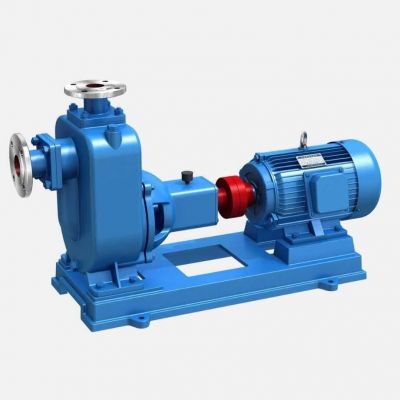
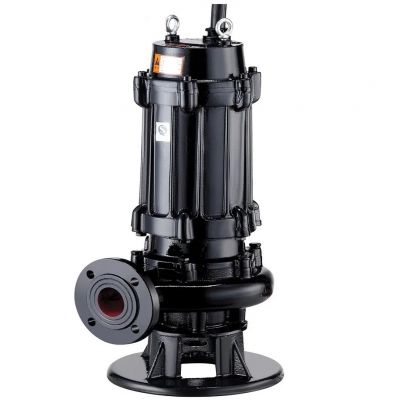
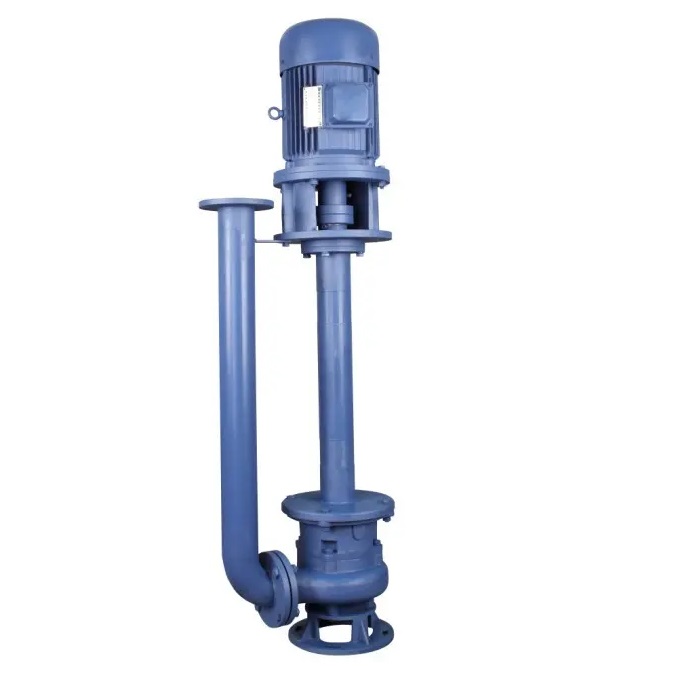
A self-priming pump does not pull liquid up. It lowers the pressure at its inlet, and atmospheric pressure pushes the liquid up the suction pipe. At sea level, atmospheric pressure equals about 10.3 m of water, and that is the theoretical limit. In practice, vapor pressure, friction in the suction pipe and the pump's own NPSH requirement use up much of it. The ZW is rated for a self-priming height of 4.5–5.5 m with a suction pipe up to 10 m long.
Two site conditions reduce the usable lift:
- Altitude. At 1,000 m above sea level, atmospheric pressure is about 9.2 m of water, so you lose more than a meter compared with sea level.
- Temperature. Warm wastewater has a higher vapor pressure and boils more easily at the low pressure inside the pump inlet.
Check the lift with an NPSH calculation at the lowest liquid level and the highest liquid temperature. Example: a pump station at 500 m altitude, wastewater at 30 °C, the lowest level 4.0 m below the pump inlet, and 0.8 m of friction loss in the suction pipe:
NPSHa = atmospheric head − vapor pressure head − static lift − suction losses
NPSHa = 9.77 − 0.43 − 4.0 − 0.8 ≈ 4.5 m
Oregon's design rules for wastewater pump stations require a safety margin of at least 6 ft (1.8 m) above the pump's NPSH required at suction-lift stations. In this example, the pump's NPSH required at the duty point must therefore be no more than about 2.7 m. If it is higher, lower the pump, shorten the suction line or choose a submersible pump.
The ZW uses an external-mixing, axial back-flow design. Its casing holds a reserve of liquid. When the pump starts, the impeller mixes this liquid with the air in the suction pipe, separates the air in the casing, discharges it and returns the liquid to the impeller. After a few cycles, the suction pipe is full and the pump delivers normally. It needs no foot valve.
The casing must be filled with liquid before the first start. After that it keeps its reserve between starts. Reliable priming depends on the installation:
- Keep the suction pipe short, no longer than 10 m, and completely airtight. A small leak lets in air without dripping, so it is easy to miss.
- Run the suction pipe so that it rises steadily to the pump, with no high points where air collects.
- Fit a check valve in the discharge, and give the air a way out during priming.
- Never start the first time without filling the casing. Self-priming does not mean the pump can start dry.
- No air leaks in the suction pipe. They are the most common cause of failed priming.
- Do not exceed the rated lift after allowing for altitude and liquid temperature.
- No suction pipe longer than 10 m. Longer pipes take too long to prime.
A submersible pump avoids suction lift entirely, but it brings its own conditions.
- Liquid temperature. The WQ is rated for liquids from 0 to 55 °C. For hotter industrial effluent, use the ZW or YW, which are rated to 80 °C.
- Motor cooling. Most submersible motors are cooled by the surrounding liquid, so the stop level must keep the motor covered. Some designs, such as the JYWQ, have an internal cooling circuit and can run down to the lowest pit level.
- Seals. A double mechanical seal in an oil chamber protects the motor. Where a moisture sensor is fitted in the oil chamber, it warns of seal wear before water reaches the windings.
- Retrieval. Guide rails and an automatic discharge coupling let you lift the pump out without entering the pit. Plan the lifting gear and overhead clearance before ordering. Never lift the pump by its cable.
- Hazardous gas. Sewage pits can contain flammable gas. A pump in the pit needs explosion-proof certification. A motor above the pit, as on the ZW and YW, avoids the problem.
| Site condition | Best choice |
|---|---|
| Lowest level within about 4.5 m of the pump; frequent maintenance | ZW self-priming |
| Pit deeper than the self-priming lift, or a long suction line | WQ submersible, or YW if the motor must stay dry |
| Liquid above 55 °C | ZW or YW, both rated to 80 °C |
| Flow above 1,000 m³/h | WQ, up to 6,000 m³/h |
| Head above 65 m | ZW, up to 70 m |
| Sludge settles on the pit floor | JYWQ, which has a mixing device that stirs sediment back into suspension |
| Long fibers, rags and plastic strips | A submersible pump with a cutter, such as the submersible non-clogging sludge pump |
Whichever layout you choose, the impeller and passages must pass the solids in the wastewater. Oregon's wastewater design rules, for example, require raw sewage pumps to pass at least a 63 mm (2½ in) sphere and preferably 76 mm (3 in), with piping and valves passing 76 mm. The ZW passes suspended solids up to 60% of the pump bore and fibers up to five times the bore. In a self-priming installation, also check the suction pipe, elbows and any strainer, because a blockage there stops the pump just as surely.
Match the material to the chemistry. On the ZW, cast iron suits liquids from pH 6 to 9 and stainless steel from pH 2 to 13. The liquid density must not exceed 1,240 kg/m³. For more on the basics, see what a sewage pump is and how it works.
The liquid level changes as the pit fills and empties, so the static head and the operating point change too. Calculate the total dynamic head at both high and low levels and compare pump curves across that range, not at one rated point. A submersible pump avoids suction losses. A self-priming pump costs less to maintain because nothing has to be lifted out of the pit. Include lifting equipment, civil works and the cost of an overflow when a pump is out of service, not just the purchase price.
- Flow, and the head at high and low pit levels.
- Pit depth, the lowest liquid level and the site altitude.
- Liquid temperature, pH and chemical content.
- Solids: maximum particle size, fibers, rags and grit.
- Whether flammable gas may be present in the pit.
- Power supply and control requirements.
Deciding between a self-priming and a submersible pump? Send your pit layout to SHINJO and we will recommend the right sewage pump. See our full ranges of sewage pumps and self-priming pumps.
The ZW is rated for a self-priming height of 4.5–5.5 m with a suction pipe up to 10 m long. The usable lift is lower at high altitude and with warm liquid, so confirm it with an NPSH calculation at the lowest pit level.
Yes. Fill the casing with liquid before the first start. The pump then keeps a reserve of liquid in the casing for later starts. Self-priming does not mean it can start or run dry.
Only within its rating. The WQ is rated for liquids up to 55 °C. For hotter industrial effluent, use a pump with the motor out of the liquid, such as the ZW or YW, which are rated to 80 °C.
A self-priming pump, because the pump, seal and motor are above ground. A submersible pump has to be lifted out on its guide rails, which needs lifting equipment and clear access above the pit.
A submersible or vertical submerged pump. A self-priming pump cannot lift more than about 4.5–5.5 m, so a deeper pit would need the pump to be installed below ground, which loses its main advantage.
