A double diaphragm pump is bought once, and its diaphragms are bought for as long as it runs. Four choices decide what the pump costs to keep: port size against the real duty, the housing and its build, the diaphragm construction for the liquid, and the spares supply. The diaphragm flexes as the pump strokes and is the part a buyer keeps replacing, so its construction and supply belong in the specification. A quote that leaves these choices open leaves the buyer to settle them in service.
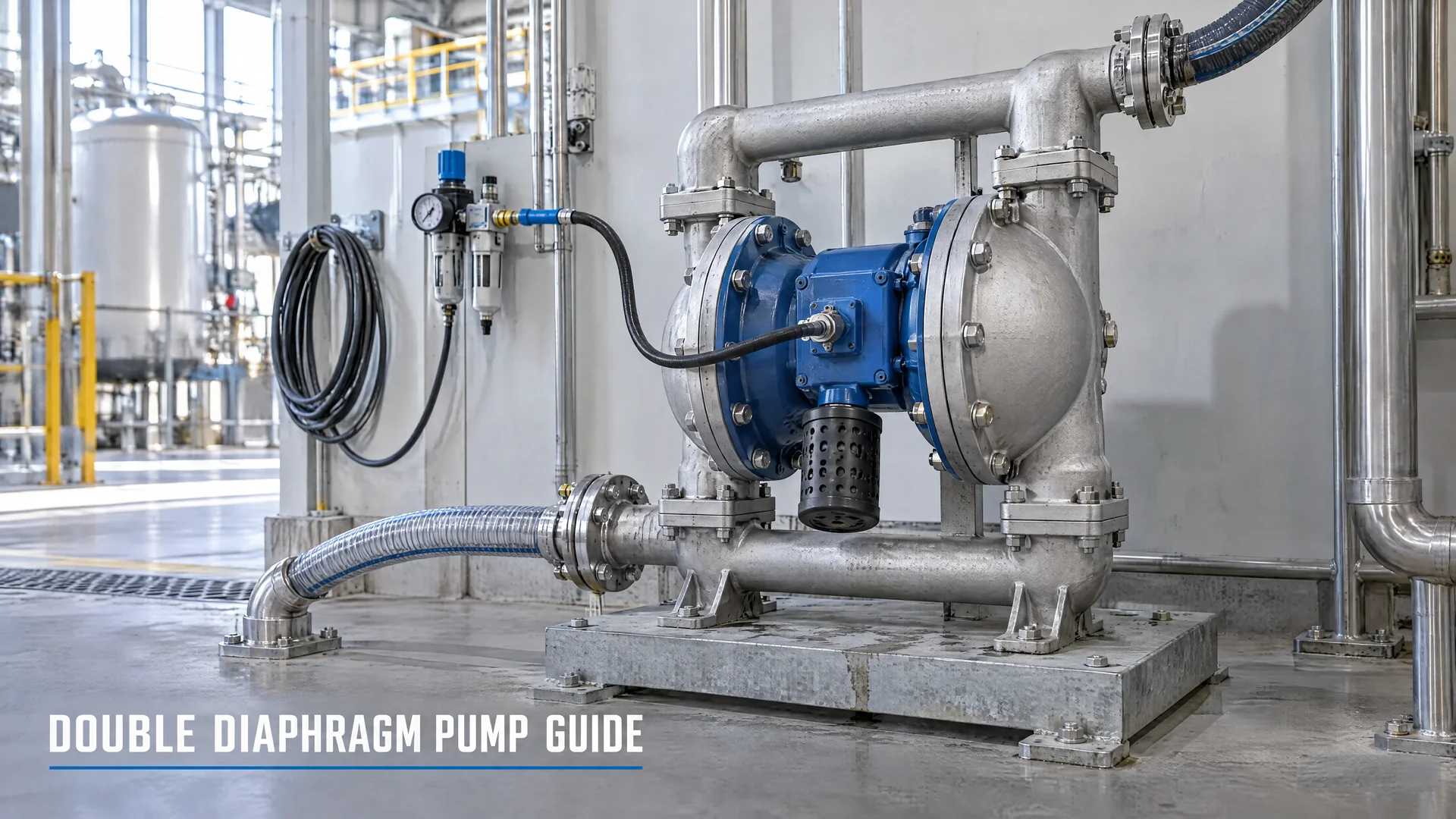
This guide is for procurement and project engineers who specify an industrial diaphragm pump and keep it running. They choose single or double design, port size, and the housing and valves. The diaphragm needs choices of its own: rubber, TPE or PTFE construction, and a replacement interval learned on the pump's own duty. The purchase turns on air or electric drive, what the quote must state, and how to check the supplier behind it. Readers are assumed to know how the pump works and how to size its compressed-air supply.
- Port size is not the duty: All-Flo's 25 mm (1 in) ball-valve pumps peak at 155.8-182 L/min (41-48 US gpm) (All-Flo, n.d.).
- Size up one port size so the pump runs at fewer strokes per minute and lasts longer (Versamatic, n.d.).
- Rubber, TPE and PTFE diaphragms trade flex life, chemical range and cost; none leads on all three (Caldwell, 2022).
- Count strokes to set a replacement interval. No standard schedule exists (Dill, 2022); the pump's own stroke history decides it.
- Bolted pumps seal more easily for hazardous liquids; clamped pumps come apart with very few tools.
- A double diaphragm pump quote should state materials by part, diaphragm grade, test standard and a spares list.
- Abstract
- Key Takeaways
- What a double diaphragm pump is, and single vs double
- Sizing a 1" diaphragm pump and every other port size
- Industrial diaphragm pump construction choices
- The diaphragm pump diaphragm: types, life and replacement
- Air-operated or electric double diaphragm pump
- Running practices that decide diaphragm life
- Reading a quote for a double diaphragm pump
- How to evaluate diaphragm pump suppliers
- Frequently Asked Questions
- Conclusion
- References
A double diaphragm pump is a positive displacement pump with two diaphragms on one shaft, each sealing its own liquid chamber (Yamada Pump, n.d.). While one diaphragm pushes liquid out of its chamber, the other draws liquid into the opposite chamber (Yamada Pump, n.d.). The drive is compressed air or an electric motor. The air-driven type falls under ANSI/HI 10.1-10.5, the Hydraulic Institute standard for positive displacement reciprocating pumps driven by compressed gas.
Yamada describes two diaphragms on a common center shaft, "always evacuating one chamber while filling the other" (Yamada Pump, n.d.). Most standard pumps carry two diaphragms and four check balls, by Yamada's account (Yamada Pump, n.d.).
Versamatic defines the two counting units: "A stroke is one shift of the diaphragm assembly moving fluid out of one chamber. A cycle is two strokes" (Versamatic, n.d.). Flow equals strokes per minute times displacement per stroke (Versamatic, n.d.). By that definition, a double pump discharges on every stroke, twice per cycle. The flow still pulses rather than running steady: All-Flo's pulsation dampeners fit at the pump's discharge to reduce pressure and flow fluctuations (All-Flo, n.d.).
Note: For the working principle, the air valve and a part-by-part walk-through, read our beginner's guide to the diaphragm pump.
Both layouts exist, and they differ in how often liquid leaves the pump.
The Hydraulic Institute's pump FAQs set the two layouts side by side as duplex and simplex air-operated pumps. In a duplex pump, one air chamber pressurizes its diaphragm and pushes liquid out while the opposite chamber exhausts and liquid is drawn in. A simplex pump works the same way, except that no liquid is discharged during the diaphragm's recharge stroke, which a spring return typically drives.
A single diaphragm pump has one liquid chamber, which must refill before it can discharge again. A double pump discharges from one chamber while the other refills. In its guide to electric diaphragm pumps, Sandpiper notes that single diaphragm pumps are "typically used in applications requiring lower flow rates and pressures".
Double diaphragm pumps are also sold as dual diaphragm pumps. The air-driven type is the air-operated double diaphragm pump, or AODD pump. The motor-driven type is the electric double diaphragm pump, or EODD (Graco, n.d.). Graco gives "membrane pump" as another name for the diaphragm pump in general (Graco, n.d.).
Metering pumps use the phrase differently: in Milton Roy's double diaphragm metering pumps, two diaphragms work in tandem, and the maker notes that a double diaphragm does not automatically imply leak detection.
Whatever the name on the quote, the specification starts with the duty: the liquid, the flow and the head the pump must meet. Port size comes after that, and it does not set the flow on its own.
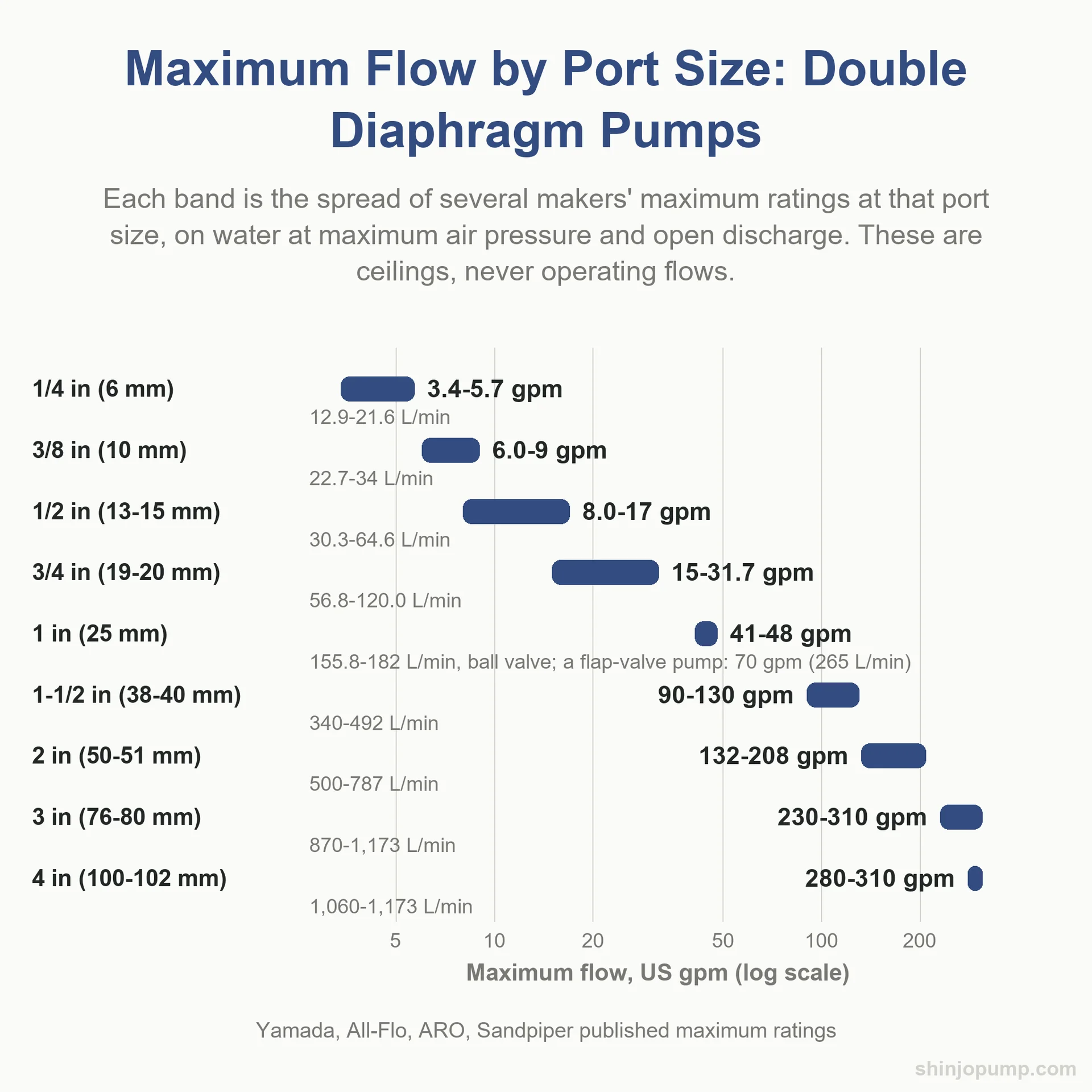
Port size fixes the pipe connection and, through the housing behind it, a ceiling on flow. Makers publish that ceiling as a model's maximum flow. A buyer reads those figures as limits and sizes a double diaphragm pump from its duty.
Ball-valve 1-inch (25 mm) double diaphragm pumps from All-Flo, Yamada and ARO carry maximum ratings of 155.8 to 182 L/min (41 to 48 US gpm), on water at maximum air pressure and open discharge (All-Flo, n.d.) (Yamada Pump, n.d.) (ARO, n.d.). Sandpiper rates its 1-inch HDF1 flap-valve pump to 265 L/min (70 US gpm) (Sandpiper, n.d.).
| Port size | Maximum flow, US gpm | Maximum flow, L/min | Valve type note |
|---|---|---|---|
| 1/4 in (6 mm) | 3.4-5.7 (Yamada Pump, n.d.) (All-Flo, n.d.) | 12.9-21.6 | Low: Yamada NDP-5; high: All-Flo A025 plastic |
| 3/8 in (10 mm) | 6.0-9 (Yamada Pump, n.d.) (All-Flo, n.d.) | 22.7-34 | Low: Yamada DP-10; high: All-Flo C038 |
| 1/2 in (13-15 mm) | 8.0-17 (Yamada Pump, n.d.) (All-Flo, n.d.) | 30.3-64.6 | Low: Yamada DP-15; high: All-Flo A050 plastic |
| 3/4 in (19-20 mm) | 15-31.7 (All-Flo, n.d.) (Yamada Pump, n.d.) | 56.8-120.0 | Low: All-Flo A075 metal; high: Yamada NDP-20 |
| 1 in (25 mm) | 41-48 (All-Flo, n.d.) | 155.8-182 | Ball valve: All-Flo, Yamada, ARO (Yamada Pump, n.d.) (ARO, n.d.). Sandpiper HDF1 flap valve at 265 L/min (70 US gpm) sits outside the range (Sandpiper, n.d.) |
| 1-1/2 in (38-40 mm) | 90-130 (ARO, n.d.) (All-Flo, n.d.) | 340-492 | Low: ARO; high: All-Flo C150 plastic |
| 2 in (50-51 mm) | 132-208 (ARO, n.d.) (Sandpiper, n.d.) | 500-787 | Low: ARO; high: Sandpiper HDF2 flap valve |
| 3 in (76-80 mm) | 230-310 (ARO, n.d.) (Sandpiper, n.d.) | 870-1,173 | Low: ARO; high: Sandpiper HDF3 flap valve |
| 4 in (100-102 mm) | 280-310 (ARO, n.d.) (Sandpiper, n.d.) | 1,060-1,173 | Low: ARO; high: Sandpiper HDF4 flap valve |
Each figure is one model's maximum rating on water at maximum air pressure and open discharge; a range is the spread of several makers' maxima at that port size, never an operating flow.
A double diaphragm pump's flow is strokes per minute multiplied by displacement per stroke (Versamatic, n.d.). Change either term and the flow moves with it. Diaphragm material changes the second: Yamada's 2018 product guide lists the NDP-40's discharge volume per cycle at 2.74 L (0.72 gal) with rubber diaphragms and 1.40 L (0.37 gal) with PTFE (Yamada America, 2018), roughly half the volume.
Makers' tables break the port-to-flow link too. All-Flo rates its 1/2-inch A050 and 3/4-inch A075 alike, at 56.8 L/min (15 US gpm) in metal and 64.6 L/min (17 US gpm) in plastic (All-Flo, n.d.), so the two ranges overlap. Sandpiper lists its 3-inch HDF3 and 4-inch HDF4 together at 1,173 L/min (310 US gpm) (Sandpiper, n.d.), the figure its HDF3 and HDF4 product page gives for the aluminum build. Shinjo lists its QBY3-25 and QBY3-25A, both DN25, at 57 and 151 L/min maximum flow (15.1 and 39.9 US gpm): one port size, two ratings.
Head on the discharge line and a lower air supply both pull the operating point below these ratings. Reading that point off the curve and sizing the compressor are set out in Shinjo's guide to AODD sizing and air use.
Versamatic advises going up one pump size whenever possible. A pump kept away from its maximum capacity runs at fewer strokes per minute, which cuts air use and extends pump life (Versamatic, n.d.). Yamada's version is shorter: "The longest running pumps are oversized and run slower" (Eklund, 2026). Yamada's guidance on PTFE diaphragms adds that a larger pump running more slowly may deliver the flow in fewer cycles, which may improve diaphragm life.
Sandpiper gives a worked example. A 1-inch (25 mm) double diaphragm pump can move 151 L/min (40 US gpm) of water against 3 m (10 ft) of head, but only near its maximum capacity and stroke rate. A pump one porting size up runs significantly slower, which extends pump life (Ellis, 2021). That duty sits just under 155.8 L/min, the rating of All-Flo's plastic A100 and the lowest 1-inch ball-valve maximum of the three makers (All-Flo, n.d.).
Versamatic and Sandpiper state the rule as one port-size step, and Yamada as oversizing. None of the three gives a percent-of-maximum figure, so ask any supplier who sizes a double diaphragm pump to a percentage for the source of that number.
Housing material, housing joints and valve type are the construction choices a buyer signs off on a double diaphragm pump. Each trades one property for another, such as chemical resistance against cost, or a tight seal against fast strip-down. Elastomer temperature limits and ball-valve particle sizes are explained in our pneumatic diaphragm pump guide.
Versamatic rates the common housing materials for a double diaphragm pump in short, plain terms. A dash marks an attribute it does not rate.
| Material | Strength and weight | Chemical resistance | Typical use or note |
|---|---|---|---|
| Aluminum | Strong, lighter | Average (Caldwell, 2022) | Popular in paint, oil, gas and mining |
| Cast iron | Very strong, heavy | - | Resists abrasion (Caldwell, 2022) |
| Stainless steel | - | Excellent | Food use (Caldwell, 2022) |
| Alloy C | - | Very high | Very costly (Caldwell, 2022) |
| Polypropylene | Light | Strong for acids and caustics (Caldwell, 2022) | Can be very affordable, depending on pump size |
| PVDF | Very strong plastic | Higher than polypropylene | Handles abrasion better than polypropylene (Caldwell, 2022) |
| Conductive acetal | - | Much like polypropylene | Prevents static discharge with flammable liquids (Caldwell, 2022) |
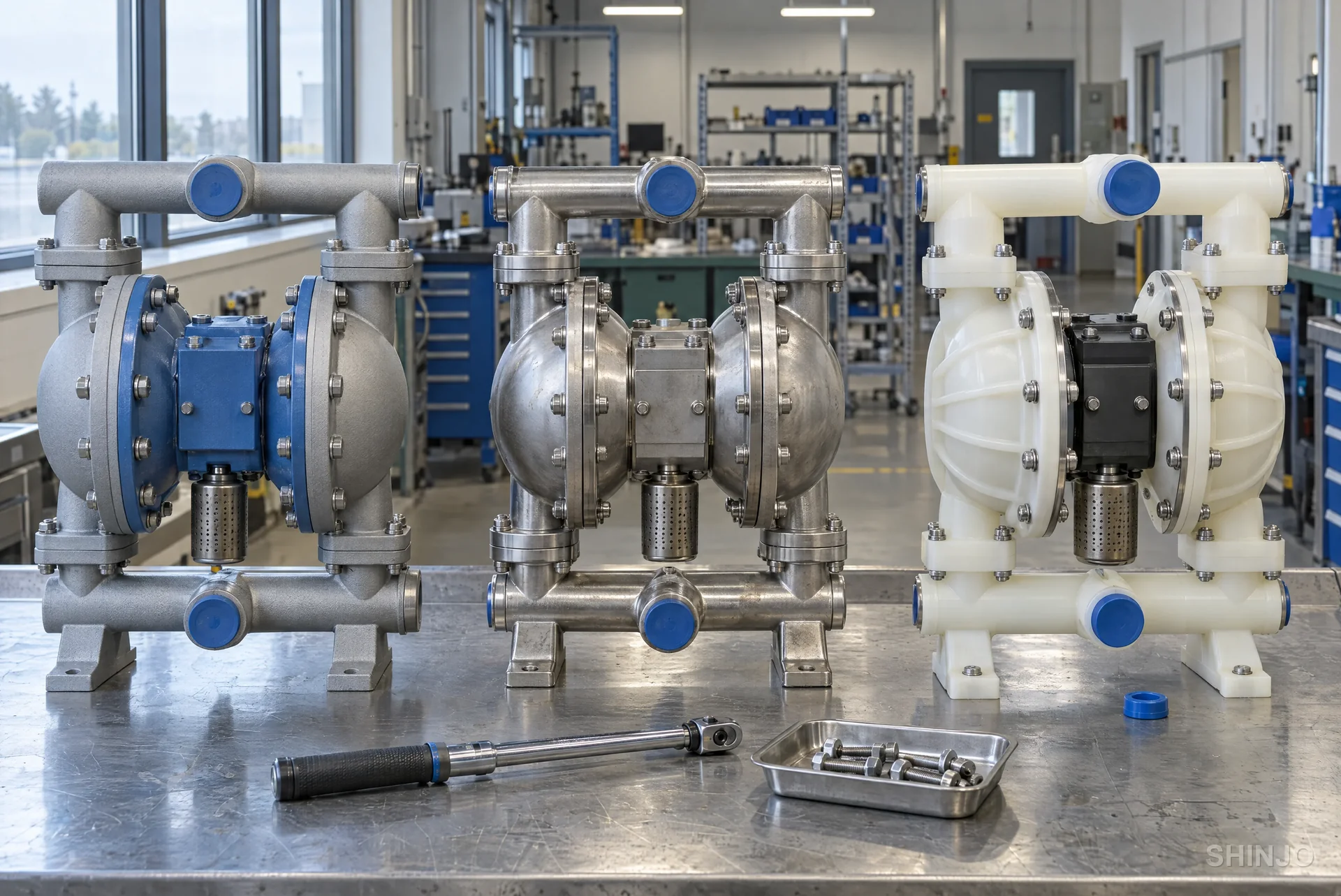
Sandpiper lists conductive grades of polypropylene, acetal and PVDF among its plastic housing options (Ellis, 2021), so a flammable liquid does not tie a buyer to acetal alone.
A housing rating describes a material family and says nothing final about a specific liquid. Check the actual liquid, at its concentration and temperature, against the maker's compatibility guide for every wetted part. Graco's materials guide advises testing a sample when compatibility is in doubt (Graco, 2024).
Versamatic's 2020 guidance on mining pumps describes clamped pumps as very simple to take apart with very few tools, with a manifold that can be removed on site, while bolted units take longer to strip down without pneumatic tools.
A bolted double diaphragm pump seals more easily than a clamped one, and the same guidance stresses that advantage when the pumped fluid is hazardous. On its packaging-market page, Wilden says the bolted configuration "offers the highest level of product containment" and ensures even pressure on the sealing faces.
Specify bolted for a hazardous liquid. Clamped earns its place where crews strip the pump on site often and the liquid allows it.
Solids size decides the check-valve type. Yamada notes that most standard pumps carry four check balls (Yamada Pump, n.d.). Sandpiper builds its heavy-duty flap valve pumps for solids too large for ball valves; across the family's port sizes, it rates them for solids of 25 to 76 mm (1 to 3 in) (Sandpiper, n.d.).
On the air side, Yamada advertises a stall-free air valve (Yamada Pump, n.d.), and Graco advertises air valves that can be serviced externally (Graco, 2024). Both are manufacturer feature claims, so ask the supplier for the air-valve service procedure in the manual before counting either one in a comparison.
Shinjo describes its cast-iron QBY3 double diaphragm pump as having "All-bolted construction with serviceable external air-valve assembly". That pairs the sealing advantage of a bolted housing with an air valve reached from outside the pump.
Housing, joints and valve type are chosen once, with the pump. The diaphragm is the part a double diaphragm pump owner keeps buying.
The liquid and the duty decide the build. Our Diaphragm Pumps range is quoted against a stated duty point, so send the flow, discharge pressure, fluid and pumping temperature with your inquiry, together with the liquid’s character: solids, viscosity, abrasiveness and corrosiveness. With those on the page, the housing and diaphragm construction can be matched to the liquid rather than left open. View the Diaphragm Pumps range
Diaphragms are the primary wear components in an air-operated double diaphragm pump (Eklund, 2026), and because both sit on one shaft, the pump flexes both of them on every stroke. A 2023 review of symmetrical diaphragm pumps in the journal Symmetry names the diaphragm and the one-way valve as the components most susceptible to erosion and damage by the transported materials (Zhao et al., 2023). Construction and duty decide how often they are replaced.

Diaphragms for a double diaphragm pump come in three material families (Zuckett, 2024): rubber, thermoplastic elastomer (TPE) and polytetrafluoroethylene (PTFE). One-piece designs join the diaphragm and its plate.
| Construction | How it is made | What it trades |
|---|---|---|
| Rubber | Synthetic rubber with a nylon fabric mesh (Zuckett, 2024) | The greatest temperature spans, per Wilden |
| TPE | Injection-molded, no fabric reinforcement (Zuckett, 2024) | Santoprene (a TPE) shares the best flex life with neoprene (a rubber), per Versamatic (Caldwell, 2022); Geolast flexes more than fabric-reinforced Buna-N at lower cost, per All-Flo |
| PTFE with backup | Non-elastic PTFE over a backup diaphragm of another material, such as neoprene or Saniflex (Hytrel) (Zuckett, 2024) | Best chemical resistance in Versamatic's list, but lower flex life and higher cost; abrasives in most cases rule it out (Caldwell, 2022) |
| One-piece | All-Flo single-piece, PTFE included, per the same All-Flo article; Wilden Chem-Fuse, no outer piston; Graco overmolded PTFE, no exposed plate (Graco, 2024) | Chem-Fuse removes the outer-piston leak point, per Wilden; Graco rates overmolded PTFE at -10 to 82 °C (14 to 180 °F), standard PTFE at 4.4 to 100 °C (40 to 212 °F) (Graco, 2024) |
Wilden's reduced-stroke PTFE diaphragm cuts stroke and displacement to limit abrasive contact with the housing. Graco claims "3x longer diaphragm life" for overmolded PTFE against standard diaphragms (Graco, 2024), and Wilden's reliability page says Chem-Fuse extends diaphragm life "by up to 10-15x"; both are maker claims. Published limits disagree as well: Graco lists Hytrel to 65.6 °C (150 °F) (Graco, 2024) and Yamada to 120 °C (248 °F) (Yamada America, 2018), so check the quoted pump's own documentation. Shinjo's AODD guide tabulates elastomer temperatures. Converting between rubber or TPE and PTFE may need different center disks, shafts, backups, balls, seats and O-rings, per Yamada's PTFE guidance. Shinjo lists NBR, neoprene, EPDM, PTFE and FEP diaphragms for its QBY3 double diaphragm pumps and states that the allowable medium temperature depends on the pump body material and the diaphragm material, so a plastic-bodied pump can be limited by its housing before its diaphragm.
For a double diaphragm pump, Yamada states that component life "is strongly influenced by the number and severity of operating cycles" (Eklund, 2026). Too much air pressure makes the pump cycle very rapidly, which Versamatic links to extra wear and premature failure; the pressure should leave the liquid time to fully enter and leave each chamber (Dill, 2022). Yamada adds that excessive inlet pressure or excessive suction lift can shorten diaphragm life (Yamada America, 2018). Sandpiper notes that flexibility typically suffers at lower temperatures and that maximum flex life cannot be expected at a material's temperature extremes (Ellis, 2021).
Abrasives tear. Versamatic's maintenance FAQs call paint an extremely abrasive fluid and expect a pump with neoprene or nitrile elastomers to break down within a relatively short time on it. All-Flo, announcing its All-Safe DRM leak sensor, calls diaphragm rupture rare and names large abrasives that tear the diaphragm as its most common cause. Hardware also loosens with creep and vibration; Sandpiper advises re-torquing to the manual with the pump not under pressure (Ellis, 2021).
A used diaphragm records how a double diaphragm pump was run. Versamatic's troubleshooting guidance pairs patterns with likely causes:
| What the diaphragm shows | Likely cause |
|---|---|
| Discoloration, cracking or bubbling around the edge | Excessive heat or chemical attack (Versamatic, n.d.) |
| Wear marks on one side | Excessive suction-side pressure or an imploded air side; keep below 0.7 bar (10 psi) of NPSH (Versamatic, n.d.) |
| Star-pattern cracking | Dry running (Versamatic, n.d.) |
| Outer diaphragm plate imprint | Over-torquing (Versamatic, n.d.) |
| Punctures | A sharp item entered the pump; fit a suction screen (Versamatic, n.d.) |
| Scratch marks on the air side | High fluid inlet pressure, most often flooded suction (Versamatic, n.d.) |
| Stretched center hole | Outer plate torqued incorrectly, or high inlet pressure overstretching the diaphragm (Versamatic, n.d.) |
Photograph each failed diaphragm and file it with the stroke count. The pattern shows whether to change the material or the way the pump is run.
On a double diaphragm pump, product at the air exhaust is the obvious sign of a failed diaphragm (Versamatic, n.d.). When a diaphragm fails, the liquid can reach the air side. Versamatic warns that an incompatible air side can then cause problems in the main and pilot air valves and in other systems on the same air line, so it advises air-side materials that also suit the liquid (Caldwell, 2022).
Monitoring systems raise the alarm sooner:
- Wilden's Wil-Gard III places sensors between the PTFE primary diaphragm and the back-up diaphragm and reacts to conductive fluids, with a stated sensitivity of 75 microsiemens.
- All-Flo's All-Safe DRM puts an early-warning sensor between the PTFE overlay and the backup, plus a second sensor in the air section.
- Yamada's DM-2 can cut the air supply and can trigger a whistle or alarm when it detects a diaphragm leak.
A conductivity sensor may miss a non-conductive solvent, so confirm the sensing principle suits the liquid.
Versamatic states that "there is no standard AODD pump maintenance schedule" (Dill, 2022). A stroke figure from another plant is a poor guide, since Yamada ties component life to the severity of operating cycles as well as their number (Eklund, 2026). The interval for a double diaphragm pump has to be learned on its own duty. Versamatic calls a stroke counter "a good way to keep track of approximately how many strokes you can expect before a diaphragm needs to be replaced" (Dill, 2022). Wilden's PCMI cycle monitor counts complete cycles from a magnet on the air-valve spool. When a diaphragm or another part has to be replaced, Versamatic advises replacing all the components at the same time, while the pump is out of service (Versamatic, n.d.).
Tip: Log the stroke count and failure pattern at every diaphragm change. Plan the next change below the shortest life seen on that duty, and re-baseline after any change of fluid, temperature, air pressure or diaphragm material.
Repair kits split a double diaphragm pump into a wet side and an air side. Wilden's parts kit flyer says its Wet Kit "includes only elastomers located on the wet side of the pump such as diaphragms, balls, seats, gaskets and o-rings (if required)" and that no air-side parts are included. Its Air Kit includes the air-valve spool. Sandpiper offers its wear parts (diaphragms, balls, seats and flaps) in kit form, and individual wear parts on both the wet and air sides. A US distributor's repair kit guide notes that a Wilden kit is coded to the pump configuration read from the model nameplate, and that a pump with integral piston diaphragms takes a different wet kit. Ask for kit part numbers that match the configuration quoted.
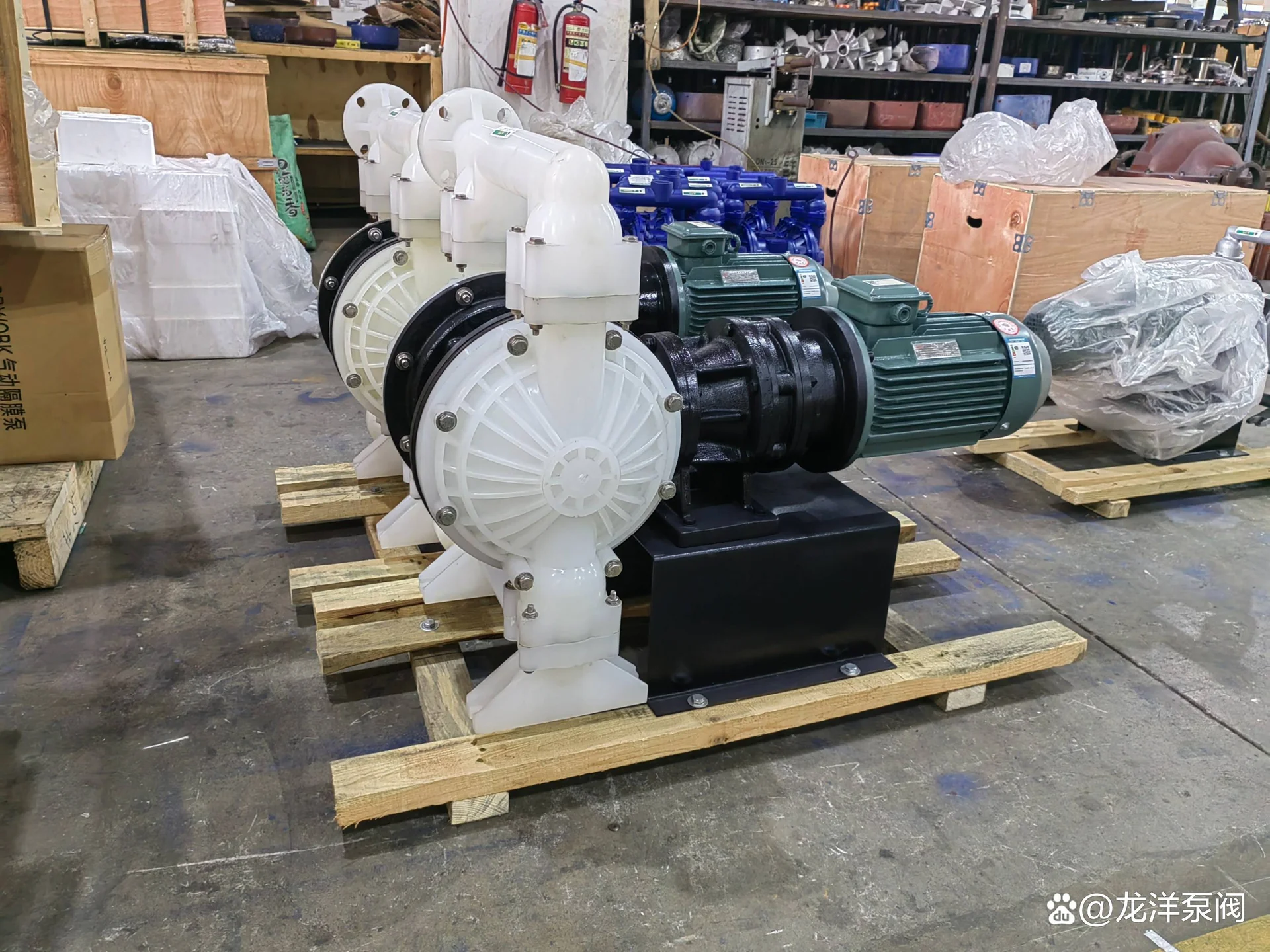
The drive sets what a double diaphragm pump costs to run. Air-operated pumps run on plant compressed air; electric ones drive the same diaphragms from a motor.
| Factor | Air-operated | Electric (motor-driven) |
|---|---|---|
| Energy source | Plant compressed air | Site electrical supply |
| Energy efficiency | Low; runs on costly compressed air (U.S. Department of Energy, 2003) | Higher, per Graco (Graco, n.d.) |
| Hazardous areas | No motor; ground it for flammable liquids (Caldwell, 2022) | Explosion-proof motor for flammable liquids (Shinjo's DBY instruction) |
| Dry running | Tolerated; sustained dry running wears the diaphragm and wastes air (Eklund, 2026) (U.S. Department of Energy, 2003) | Model-specific |
| Controls | Regulator set to the maximum head required; flow control valve sets speed (U.S. Department of Energy, 2003) | Motor matched to phase, voltage and frequency |
| Initial vs running cost | Can cost less to buy; typically more to maintain (Graco, n.d.) | Lower lifetime cost, per Graco (Graco, n.d.) |
The US Department of Energy's 2003 compressed air sourcebook calls compressed air probably the most expensive form of energy in a plant, with a typical overall efficiency of 10 to 15 percent (U.S. Department of Energy, 2003). It lists diaphragm pumps among potentially inappropriate uses (U.S. Department of Energy, 2003) and notes they are commonly installed without regulators or with regulators set higher than necessary (U.S. Department of Energy, 2003).
The efficiency figure covers compressed air systems in general, not one pump. At pump level, Versamatic writes that "operating AODD pumps costs more than purchasing them" (Dill, 2022), and its life-cycle cost article puts the purchase price at 5 to 20 percent of total cost of ownership. Shinjo's AODD sizing and air-use guide converts air demand into kilowatts and running cost.
Graco claims its electric double diaphragm pump cuts energy consumption "up to 5x" against an air-operated one (Graco, n.d.), and that one of its electric pumps can reduce energy usage and costs "by up to 80%" (Graco, n.d.). A fivefold cut is an 80% saving, so the two figures are one vendor claim; "up to" marks the best case. Shinjo offers its DBY motor-driven pump where plant air is unavailable.
Graco's electric range covers 25 to 50 mm (1 to 2 in) ports, against 6 to 76 mm (1/4 to 3 in) for its air-operated pumps (Graco, 2024). The motor must match the site supply: ARO offers its three-chamber EVO 300 for 3-phase 50/60 Hz at 200-240 V, 380-500 V or 525-600 V. Shinjo requires an explosion-proof motor on the DBY for flammable liquids; that is an installation instruction, and the quote should still name the pump's hazardous-area rating.
Air-operated pumps tolerate dry running because they use no close tolerances; Yamada calls the capability a feature, not an operating strategy (Eklund, 2026). Running empty, a pump "will rapid cycle, wearing out the diaphragm and wasting air", per the US DOE sourcebook (U.S. Department of Energy, 2003).
Electric double diaphragm pumps differ by model. Sandpiper's electric pump guide says an EODD pump "can function safely even when the fluid source runs dry" and ARO's electric pump overview lists run-dry capability, while Shinjo states its DBY is "strictly forbidden to run dry". Ask the quote to state the dry-running limit for the exact double diaphragm pump offered.
Yamada states that the life of a double diaphragm pump's components is strongly influenced by the number and severity of its operating cycles (Eklund, 2026), and its 2018 product guide adds that excessive inlet pressure or excessive suction lift can shorten diaphragm life (Yamada America, 2018). Air pressure, stroke rate and inlet conditions are set on site, after the pump is bought.
- Set the air regulator to the duty. The US Department of Energy's compressed-air sourcebook says "the regulator should be adjusted to equal the maximum head that the pump is required to provide" (U.S. Department of Energy, 2003). Check the setting again whenever the discharge line changes.
- Fit speed control. On a double diaphragm pump, a flow control valve upstream of the regulator gives speed control, per the sourcebook (U.S. Department of Energy, 2003). Fewer strokes per minute mean fewer flex cycles.
- Hold inlet pressure down. Versamatic advises keeping suction-side pressure below 0.7 bar (10 psi) of NPSH (Versamatic, n.d.). Measure inlet pressure on a flooded suction before start-up, and keep suction lift inside the datasheet figure.
- Screen the suction. Versamatic traces diaphragm punctures to sharp items entering the pump and advises fitting a suction screen (Versamatic, n.d.). Clean it on a schedule; a clogged screen starves the inlet.
- Limit dry running. An air-operated double diaphragm pump tolerates dry running because it uses no close tolerances, Yamada explains, yet a dry pump cycles faster, uses more air and adds diaphragm fatigue without moving liquid (Eklund, 2026). Versamatic warns that prolonged dry running weakens the diaphragm and recommends a pneumatic liquid level controller (Versamatic, n.d.); Verder's guide to diaphragm pump failures describes a flow stop valve that cuts the air when air consumption rises.
- Re-torque with the pump depressurized. Sandpiper notes that housing hardware loosens through material creep, vibration in transit and temperature changes, and advises re-torquing to the manual with the pump not under pressure (Ellis, 2021). Transit vibration makes installation the first check.
- Match the air side to the liquid. A failed diaphragm can let liquid reach the air side, so Versamatic advises air-side materials that also suit the liquid (Caldwell, 2022).
Pulsation dampeners and grounding belong to the same installation; Shinjo's pneumatic diaphragm pump guide covers pulsation and static grounding for air-operated double diaphragm pumps.
A quote records the pump a supplier will build. Before you compare a diaphragm pump for sale from two suppliers, check that both quotes answer the same duty questions and name the same parts.
Graco and Yamada each publish the data they ask for before specifying a pump (Graco, 2024) (Yamada America, 2018). A complete quote for a double diaphragm pump restates the duty it was sized for and commits to the build:
- The liquid: solids, pH, viscosity, specific gravity, abrasiveness and corrosiveness.
- Pumping temperature, required flow rate and operating condition.
- Feed tank position, suction line length and vertical rise.
- Discharge distance and discharge pressure or total dynamic head.
- Hose diameters and other installation requirements.
- Available air supply; our AODD sizing guide lists the air-side fields.
- Materials by part: housings, diaphragms, check balls, seals and connecting rod.
- Certifications, production tests and whether a witnessed lab test is required.
Sandpiper's RFQ data sheet for its gas-operated G15 pump lists a 100% leak test of gas-containing housings, a hydrostatic test of pressure parts except the diaphragms at five times the maximum rated operating pressure, and static dissipation not exceeding 1 megaohm between the grounding connection and each metal component. A quote that only says "tested" cannot be checked.
Price for a double diaphragm pump follows the build: port size, housing material, diaphragm construction, valve type, drive (air or electric), accessories (pulsation dampener, leak detection) and the documents and tests ordered. Versamatic names PTFE and Viton the most expensive diaphragm materials (Caldwell, 2022), and Graco states that an air-operated pump can cost less to buy than an electric diaphragm pump (Graco, n.d.). Witnessed tests and material certificates are priced items too, so compare quotes line by line, never by the total.
All-Flo states that its mounting feet and liquid porting location are "designed to match competitors' footprint" (All-Flo, n.d.). That claim covers bolts and pipes only. Wet-end parts are a separate question. Even within one pump, Yamada's PTFE guidance warns that converting between rubber or TPE and PTFE diaphragms can need different center disks, shafts, backup diaphragms, balls, seats and O-rings. Wilden's kit flyer codes its repair kits by pump size, configuration, material and air distribution system.
When a double diaphragm pump replaces an existing one, have the quote name the model and part numbers it claims to match, then check them against a dimensioned drawing.
Judge a supplier by the documents it can produce before the order: a factory that builds the double diaphragm pump holds them, and a reseller has to ask for them.
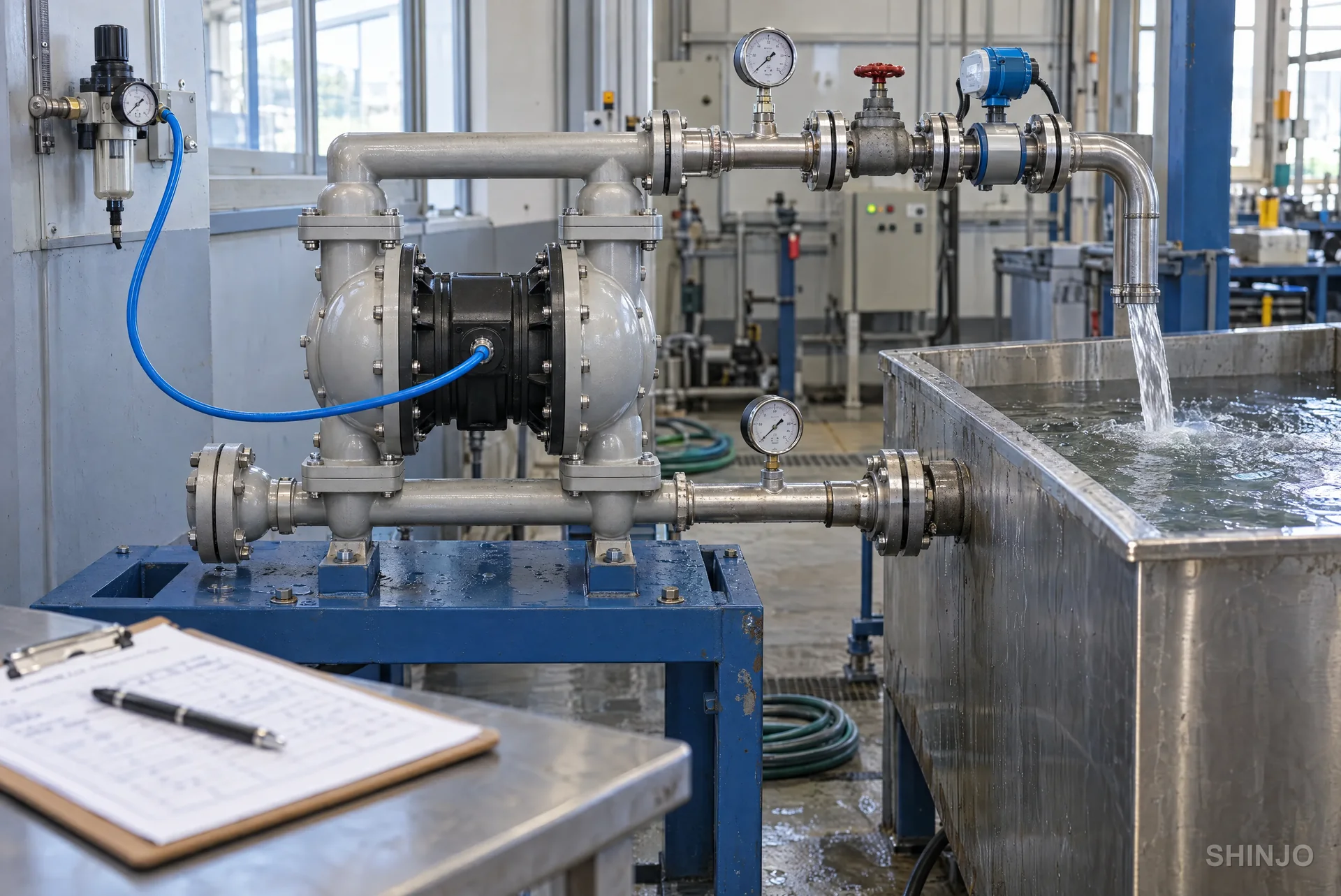
A maker designs and tests the pump. An assembler builds it from bought-in major parts. A trader resells it. Ask for this evidence on the exact double diaphragm pump quoted:
- The supplier's own performance curve and test record for that model.
- Material certificates for wetted parts, stating the EN 10204 type.
- A spare-parts list with part numbers, wet side and air side.
- A sectional drawing and a dimensioned drawing.
- An installation, operation and service manual.
- The number and issuer of any management-system certificate it names.
ANSI/HI 10.6 Air-Operated Pump Tests, the Hydraulic Institute standard current in its 2021 edition, sets uniform procedures for mechanical integrity in operation, performance, NPSH/NPIP, suction lift, hydrostatic and noise testing of air-operated diaphragm and bellows pumps. Two makers' double diaphragm pump curves tested to it can be compared on one basis.
ANSI/HI 10.1-10.5, current in its 2021 edition, covers nomenclature, definitions, application and operation. When HI released the 2004 editions, it said the 10.6 tests are based on water at ambient temperature unless otherwise noted. Ask which test liquid and temperature the supplier's curve used.
Under EN 10204, each inspection document type certifies something different:
| EN 10204 type | What the document is |
|---|---|
| 2.1 | The manufacturer's statement of compliance with the order |
| 2.2 | Adds the results of non-specific inspection |
| 3.1 | Reports the results of specific inspection; validated by the manufacturer's authorized inspection representative, independent of the manufacturing department |
| 3.2 | Validated by the manufacturer's authorized inspection representative together with the purchaser's authorized inspection representative or an inspector designated by official regulations |
Name the type in the order.
Search IAF CertSearch's ISO 9001 register by company, certificate number or certification body to see whether a certificate is active, suspended or withdrawn. The same page notes that ISO 9001 clause 8.4 requires control of external providers, so a certified organization must evaluate, select and monitor its suppliers. Ask a certified supplier how it does so.
A double diaphragm pump needs new diaphragms for as long as it runs. A Pumps & Systems article on counterfeit AODD parts describes the warning signs: look-alike part numbers with an added prefix, missing manufacturing date stamps and parts shipped in unbranded bags. Fitting them can void the warranty, reduce flow, cause more breakdowns and compromise chemical compatibility. Buy diaphragms from a verified supplier or one the pump maker recommends (Zuckett, 2024). Before ordering, get in writing who will supply the pump's diaphragm kits.
What is a double diaphragm pump?
A double diaphragm pump is a positive-displacement pump with two diaphragms on one shared shaft, so one chamber discharges while the other fills (Yamada Pump, n.d.). Compressed air drives the AODD version and an electric motor drives the EODD version (Graco, n.d.). The same machines are also sold as dual diaphragm pumps.
What is the main difference between a single diaphragm pump and a double diaphragm pump?
The double design has two chambers on one shaft and discharges on every stroke, two discharges per cycle (Versamatic, n.d.). The Hydraulic Institute describes both simplex and duplex air-operated pumps, and notes that a simplex pump discharges no liquid during its recharge stroke. Writing about electric pumps, Sandpiper says single diaphragm pumps typically serve lower flow rates and pressures.
What are the disadvantages of a diaphragm pump?
Air-operated models use compressed air: the US DOE calls it probably the most expensive form of energy in a plant (U.S. Department of Energy, 2003), at 10 to 15 percent typical overall efficiency (U.S. Department of Energy, 2003). A 2023 review in Symmetry names the diaphragm and one-way valve as the parts most susceptible to erosion and damage (Zhao et al., 2023). The flow also pulses, which is why Versamatic recommends a surge suppressor where steadier pressure is needed (Versamatic, n.d.).
Can a double diaphragm pump run dry?
Air-operated models tolerate dry running: they use no close tolerances and do not depend on the pumped liquid for lubrication or cooling (Eklund, 2026). Sustained dry running still wastes compressed air and adds diaphragm fatigue and wear on other internal parts, because the empty pump cycles faster (Eklund, 2026). Shinjo permits short-time dry running on its QBY3 but forbids it on its electric DBY.
Do pump diaphragms need to be replaced?
Yes. Versamatic states there is no standard AODD pump maintenance schedule and advises keeping notes on how each pump responds (Dill, 2022). A stroke counter tracks roughly how many strokes a diaphragm lasts before it needs replacing (Dill, 2022). When a part has to be replaced, Versamatic advises replacing all the components at the same time (Versamatic, n.d.).
What is the maximum flow rate of a 1 inch diaphragm pump?
Ball-valve 25 mm (1 in) models from All-Flo, Yamada and ARO top out at 155.8 to 182 L/min (41 to 48 US gpm), on water at maximum air pressure and open discharge (All-Flo, n.d.; ARO, n.d.; Yamada Pump, n.d.). Sandpiper rates its same-size flap-valve HDF1 to 265 L/min (70 US gpm) (Sandpiper, n.d.). These are ceilings, so size up one port size (Versamatic, n.d.).
Are diaphragm pumps positive displacement?
Yes. The Hydraulic Institute's ANSI/HI 10.1-10.5 covers air-operated pumps as positive-displacement reciprocating pumps driven by compressed gas. Flow equals strokes per minute times the volume each stroke displaces (Versamatic, n.d.). That displacement changes with the diaphragm material: Yamada publishes separate rubber and PTFE performance curves (Yamada America, 2018).
How much does a diaphragm pump cost?
Price follows the specification: port size, housing and diaphragm materials, drive, and the tests and certificates ordered. Versamatic ranks PTFE and Viton the most expensive diaphragm materials (Caldwell, 2022). Graco says air-operated pumps can cost less to buy than electric ones (Graco, n.d.). Versamatic notes that operating an AODD pump costs more than buying it (Dill, 2022).
What a double diaphragm pump costs to keep, diaphragms included, is decided before the order is placed.
Size for the duty. A catalog flow figure is one model's maximum on water at maximum air pressure, so match the pump to the flow and head the process needs. Go up one port size: fewer strokes for the same volume mean fewer flex cycles on each diaphragm.
Let the liquid choose the housing and the diaphragm. Rubber, TPE and PTFE each trade flex life against chemical range at a different cost; check the choice in a compatibility source. No universal replacement interval exists, so count strokes and read each failed diaphragm for its cause.
Choose air or electric drive on what compressed air costs the plant and on the maker's dry-running statement for that model. Hold the quote to materials by part, the diaphragm grade, the test standard and a spares list, and ask whether parts interchange. Judge the supplier on test reports and material certificates you can check.
- Versamatic. (n.d.). The Versamatic AODD pump troubleshooting guide. Retrieved October 15, 2026, from https://www.versamatic.com/resources/aodd-pump-troubleshooting-guide-pillar-page
- Caldwell, T. (2022, February 1). Air-operated double-diaphragm (AODD) pump materials selection. Versamatic. https://www.versamatic.com/blog/aodd-pump-materials-what-to-use-and-why
- Dill, J. (2022, April 1). How AODD pump preventative maintenance helps you avoid failure. Versamatic. https://www.versamatic.com/blog/how-to-maintain-your-aodd-pump-to-avoid-failure
- Yamada Pump. (n.d.). Yamada diaphragm pump NDP series. Retrieved October 15, 2026, from https://www.yamadapump.com/products
- Yamada America. (2018). Yamada product guide [Product catalog]. https://www.yamadapump.com/assets/literature/guides/Yamada_2018_US-ENG_Product_Guide.pdf
- Eklund, R. (2026, September 1). Can an AODD pump run dry? Understanding the costs of dry running. Yamada Pump. https://www.yamadapump.com/blog/can-an-aodd-pump-run-dry-understanding-the-costs-of-dry-running
- All-Flo. (n.d.). Air operated double diaphragm pumps: Product catalog. PSG. Retrieved October 15, 2026, from https://www.psgdover.com/docs/default-source/all-flo-docs/brochures/all-flo-product-catalog.pdf?sfvrsn=16d2da38_16
- ARO. (n.d.). What is the maximum capacity of AODD pump? Ingersoll Rand. Retrieved October 15, 2026, from https://www.arozone.com/en/tools/blog/what-is-the-maximum-capacity-of-aodd-pump
- Sandpiper. (n.d.). Heavy duty flap pumps, metallic & non-metallic. Retrieved October 15, 2026, from https://www.sandpiperpump.com/pumps/heavy-duty-flap
- Ellis, T. (2021, June 4). The 5 most common AODD pumping mistakes and how to avoid them. Sandpiper. https://www.sandpiperpump.com/blog/most-common-aodd-pumping-mistakes
- Graco. (2024). Materials of construction guide (Form No. 345089, Rev. D). https://www.graco.com/content/dam/graco/com_documents/345/345089/345089EN-D.pdf
- Graco. (n.d.). How does a diaphragm pump work and what is it used for? Retrieved October 15, 2026, from https://www.graco.com/us/en/in-plant-manufacturing/solutions/articles/benefits-of-an-electric-diaphragm-pump.html
- U.S. Department of Energy. (2003). Improving compressed air system performance: A sourcebook for industry (2nd ed., DOE/GO-102003-1822). Compressed Air Challenge. https://www1.eere.energy.gov/manufacturing/tech_assistance/pdfs/compressed_air_sourcebook.pdf
- Zhao, K., Lou, Y., Peng, G., Liu, C., & Chang, H. (2023). A review of the development and research status of symmetrical diaphragm pumps. Symmetry, 15(11), Article 2091. https://doi.org/10.3390/sym15112091
- Zuckett, T. (2024, April 10). How to select the most efficient diaphragm for an AODD pump. Processing. https://www.processingmagazine.com/pumps-motors-drives/aodd-pumps/article/55016664/how-to-select-the-most-efficient-diaphragm-for-an-aodd-pump
Last reviewed and updated: October 2026. Author: Shinjo Pump engineering team. For pump selection support or a quotation on your duty point, contact our team.
