A pneumatic diaphragm pump, also called an AODD pump (air-operated double diaphragm), is specified from its air side. Discharge pressure cannot exceed the air pressure driving the pump: standard 1:1 ratio AODD pumps are rated to 125 psi (8.6 bar) (Versamatic, n.d.-a). Flow follows from that same rule, and the pump's air consumption at the duty point, read off the manufacturer's performance curve in SCFM, sets three things at once: the delivered flow, the compressor horsepower the plant must provide, and the hourly electricity cost of running the pump. Suction lift, viscosity, solids and elastomer choice only shift the numbers on that same curve.
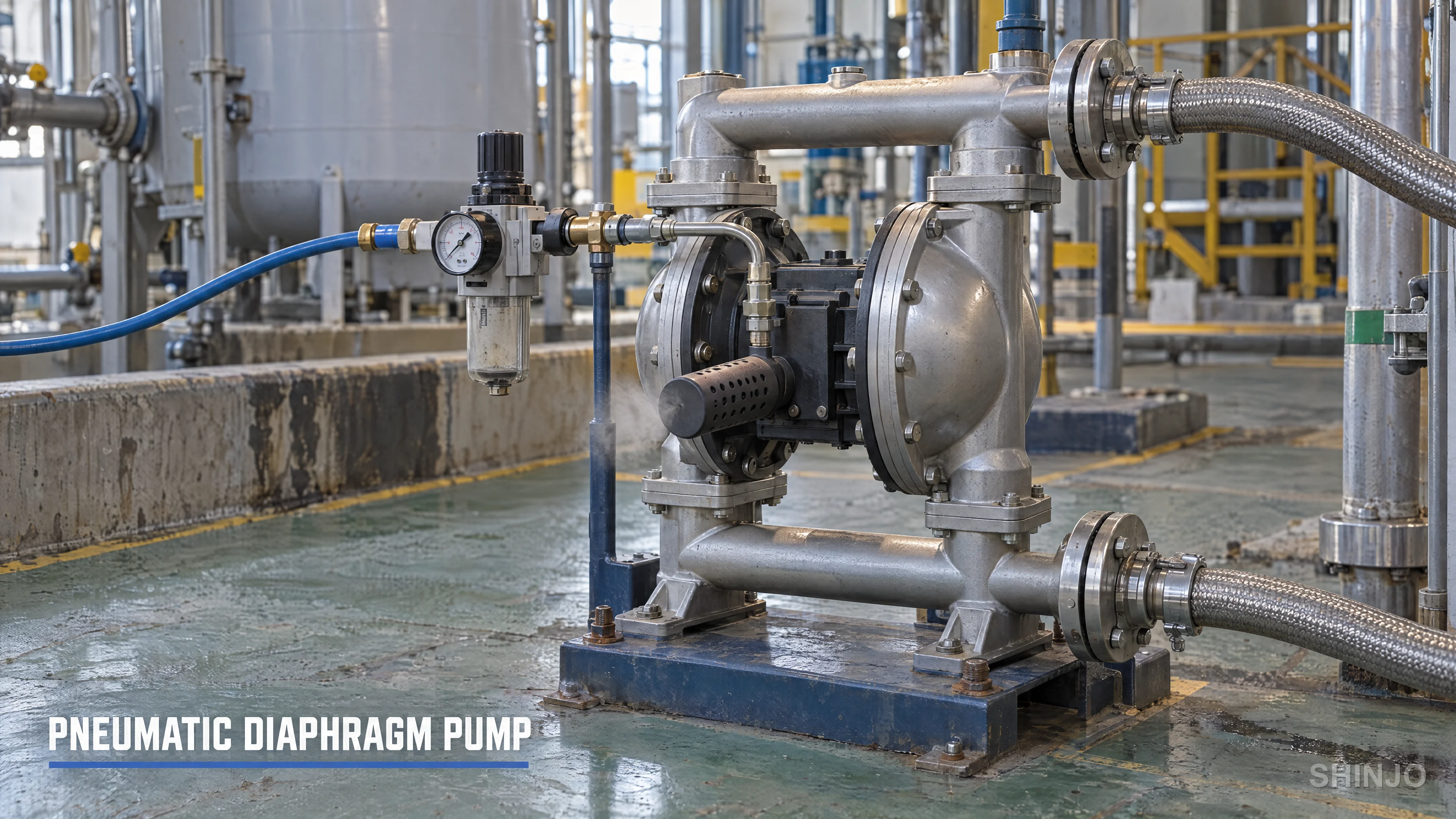
This guide is for procurement and project engineers who arrive with a duty and must specify or approve a pneumatic diaphragm pump against it. It covers the 1:1 rule, reading the performance curve, converting SCFM to compressor size and hourly cost, derating for suction lift, viscosity and solids, matching housings and elastomers to temperature and chemistry, what ATEX asks of an air-driven pump, when an electric diaphragm pump is the better buy, and the AODD pump specification a vendor needs in an RFQ.
- The 1:1 rule. An AODD pump's discharge pressure cannot exceed its air inlet, rated to 125 psi (8.6 bar).
- Read the curve. At your flow and discharge pressure, the air-consumption lines give the SCFM the pump will draw.
- Size the compressor. Around 1 hp per 4.5 SCFM, the PSG/Blackmer rule of thumb.
- Air is the running cost. At an illustrative $0.15/kWh, 118 SCFM of compressed air costs about $2.94 an hour to generate.
- Elastomer limits vary by manufacturer. PTFE trades flex life for chemical resistance, so check the chosen pump's own documentation.
- Air drive is not ATEX. Ask the supplier for the Ex marking and ground the pump, piping and containers.
- Continuous high-duty transfer favors electric. An electric diaphragm pump can use far less energy than compressed air.
- Abstract
- Key Takeaways
- What a pneumatic diaphragm pump is, in one air cycle
- Glossary
- The 1:1 rule: air pressure caps discharge pressure
- How to read an AODD pump performance curve
- Air consumption, compressor size and running cost
- Suction lift, viscosity and solids change the curve
- Wetted materials and elastomers: temperature, chemistry, flex life
- Hazardous areas: air-driven is not the same as ATEX-rated
- When an AODD pump is the wrong choice
- The AODD specification to send with an RFQ
- Frequently Asked Questions
- Conclusion
- References
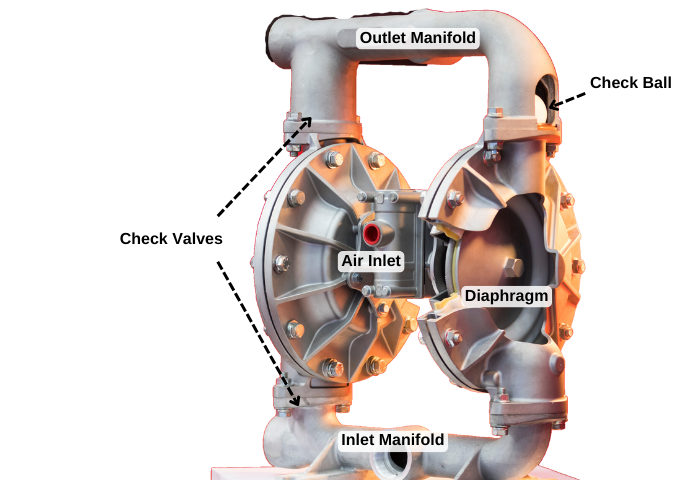
A pneumatic diaphragm pump, also called an AODD pump (air-operated double diaphragm pump), is a positive-displacement pump in which compressed air, switched by an internal air valve, drives two diaphragms joined by a shaft; while one chamber discharges the other fills, and four check valves keep the liquid moving one way. The liquid never passes through the air valve. Shinjo's QBY catalog names the same machine both an "Air Operated Double Diaphragm Pump (AODD)" and a "Pneumatic Diaphragm Pump"; the two terms describe one design.
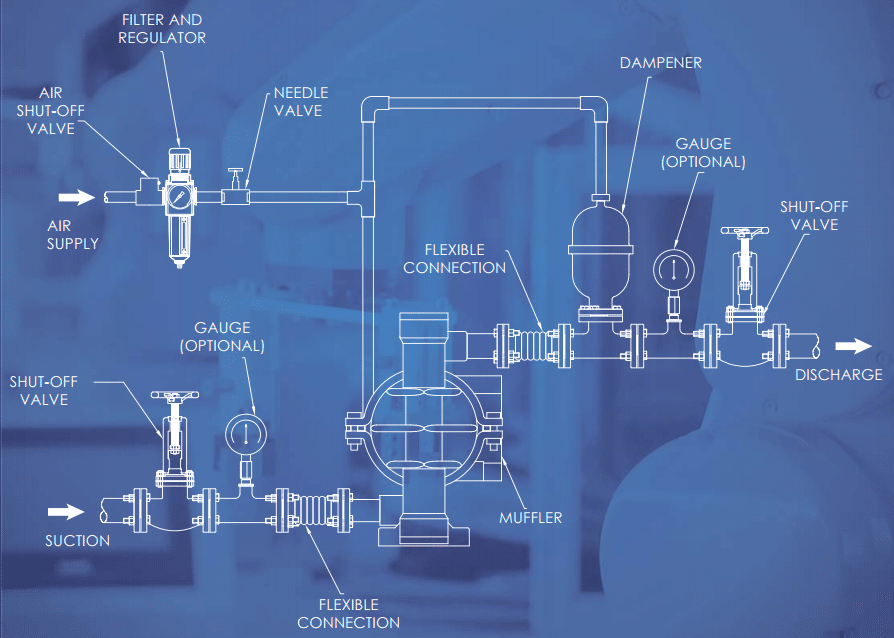
The air side receives compressed air through a filter-regulator and gauge, distributes it alternately between the two chambers, and vents each spent charge through an exhaust muffler on the center section. The liquid side stays sealed from the air side by the diaphragms; four check valves, two suction and two discharge, sit in the manifolds. For a component-by-component tour, see Shinjo's full parts walkthrough of the AODD pump.
A pneumatic diaphragm pump (AODD pump) moves liquid by shifting two diaphragms joined by a shaft with alternating compressed air; flow equals strokes per minute times displacement per stroke. Versamatic states a 2-inch bolted metal pump displaces 0.60 gal (2.27 L) per stroke, and stroke rate falls as back pressure rises (Versamatic, n.d.-a).
A stroke is one shift of the diaphragm assembly; a cycle is two strokes. More inlet air raises the stroke rate; more back pressure lowers it. Because discharge alternates between chambers, the output pulses at the stroke frequency, so downstream equipment sensitive to pressure ripple needs a dampener (Yamada Pump, n.d.-b).
- Stroke: one shift of the diaphragm assembly from one side to the other.
- Cycle: two strokes, one full oscillation of the pair.
- Displacement per stroke: the fixed liquid volume moved per stroke.
- SCFM: standard cubic feet per minute; the pump's compressed-air demand at stated inlet conditions.
Standard 1:1 ratio AODD pumps can produce pressures up to 125 psi (8.6 bar), which in practice caps the discharge a pneumatic diaphragm pump can deliver (Versamatic, n.d.-a). The inlet air pressure is the ceiling for the outlet discharge pressure. At any useful flow the discharge sits below the inlet, because pressure difference is what pushes the liquid through the check valves.
"1:1" describes the ratio of maximum liquid discharge pressure to air inlet pressure on the datasheet. Global Pumps' worked example makes the practical picture clear: 7 bar of inlet air delivers 200 L/min at 4 bar of discharge pressure (Global Pumps, n.d.). Where the plant compressed-air header could exceed 8.6 bar, a filter-regulator belongs upstream of the pump so the inlet never crosses the standard 125 psi ceiling. Shinjo lists its QBY3 series with an outlet pressure of 0.7 MPa (7 kgf/cm²) against an air supply of 0.3 to 0.7 MPa; its older QBY catalog lists 6 kgf/cm² discharge pressure against a 7 kgf/cm² maximum air supply. Both readings are consistent with the 1:1 rule.
A duty stated in meters of head must be converted to pressure before comparing it with air supply. For water at specific gravity 1.0, 10.2 m of head is about 1 bar; divide by the liquid's specific gravity for other fluids. Shinjo lists a maximum head of 70 m for its QBY3 series; that head must be expressed as bar before it is compared with the air supply. Redo the conversion for a liquid heavier or lighter than water.
Some AODD designs use a 2:1 ratio that roughly doubles the discharge pressure by trading flow and air. Consider one when the duty needs more than the standard 125 psi ceiling and the compressor has headroom; expect lower flow and higher air use per liter delivered. Ask the manufacturer for the model's own curves and air-consumption lines before comparing a 2:1 unit with a standard pneumatic diaphragm pump.
- 125 psi the standard 1:1 AODD pump air-inlet ceiling, per Versamatic (Versamatic, n.d.-a)
- 8.6 bar metric equivalent of the same 1:1 pressure limit (Versamatic, n.d.-a)
- 10.2 m water head equal to about 1 bar at specific gravity 1.0
- 7 bar in what Global Pumps needs for 4 bar out at 200 L/min (Global Pumps, n.d.)
To size a pneumatic diaphragm pump, plot the duty point where discharge pressure meets required flow on the manufacturer's curve, then read air-inlet pressure and SCFM at that intersection. Global Pumps illustrates it: 200 L/min at 4 bar discharge needs 7 bar inlet air at 60 SCFM (Global Pumps, n.d.), about 1.7 m³/min.
One chart carries four families. The horizontal axis reads flow in L/min or US gpm. The vertical axis reads discharge pressure or head. Rising curves from left to right label air inlet pressure in bar or psi. A second set sloping the opposite way labels air consumption in SCFM or m³/min. A valid reading finds where all four agree, so confirm the plant compressor supplies that pressure and volume before the model is chosen.
| Curve element | What it shows | How to use it |
|---|---|---|
| Flow axis | Discharge flow, L/min or US gpm | Enter your duty flow |
| Pressure axis | Discharge pressure or head | Enter your duty pressure |
| Air-inlet curves | Air pressure at the pump inlet, bar or psi | Read the curve through the intersection |
| Air-consumption curves | Air use, SCFM or m³/min | Read the second curve at the same point |
Follow Global Pumps' intersection method. Draw a horizontal line from 4 bar and a vertical line from 200 L/min. Their meeting point sits on the 7 bar air-inlet curve and the 60 SCFM air-consumption curve. That is 7 bar inlet air at 60 SCFM, or about 1.7 m³/min (1 SCFM ≈ 0.0283 m³/min). Manufacturer conventions differ. PSG's Blackmer example places a similar duty between the 60 and 80 SCFM lines, about 72 SCFM (PSG Blackmer, 2022). Never blend three curves; use only the curve for the model quoted.
Steps to read any AODD curve:
- Confirm the fluid. Published curves are drawn for water at specific gravity 1.0 (Van Ormer, n.d.).
- Locate duty flow on the horizontal axis.
- Locate duty pressure on the vertical axis.
- Mark the intersection of the two lines.
- Read the air-inlet curve passing through that point in bar or psi.
- Read the air-consumption curve at the same point in SCFM or m³/min.
The outer envelope of the curve is the pump running at maximum air pressure and maximum flow. Do not size a duty point on that line. Leave margin for conditions the water test cannot show: higher viscosity, suction lift, diaphragm and check-ball wear, and pressure spikes on the discharge. Run inside the envelope, not on it. If the supplier publishes only a partial curve or none at all (Shinjo's QBY3 landing page shows no air-consumption lines), ask for the full curve with both air families plotted before the pump is selected.
A generic 2-inch pneumatic diaphragm pump (AODD pump) uses 90 to 120 scfm at an average 95 psig inlet, per Compressed Air Best Practices (Van Ormer, n.d.). That is the number to start from when a duty is not yet on a curve, and it is why air is treated as its own line on the specification: the pump has no motor, so every drop of duty is paid for by the compressor.
PSG/Blackmer's rule of thumb sizes the compressor at about 1 hp per 4.5 SCFM (PSG Blackmer, 2022). In its own worked example, 72 SCFM divided by 4.5 gives 16 hp; because industrial compressors are sold in 5 hp increments, round up to a 20 hp unit. Electric horsepower converts to kilowatts at kW = hp x 0.746, which is the input a utility bill sees.
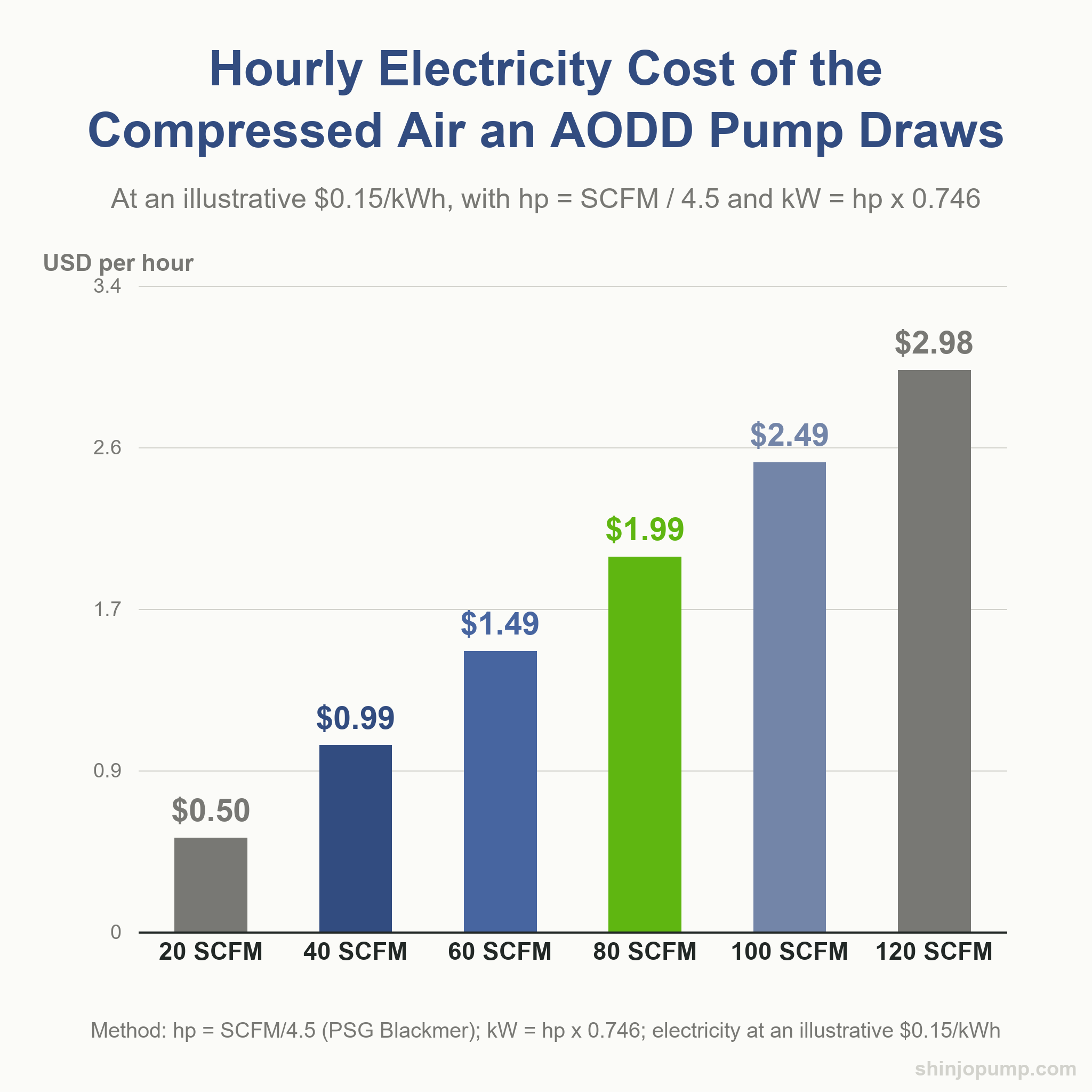
Take All-Flo's published duty point of 118 SCFM (from a 2-inch pump at 80 psi inlet, 20 psi discharge) and apply the PSG/Blackmer chain: 118 SCFM divides by 4.5 to 26.2 hp; 26.2 hp times 0.746 gives 19.6 kW; at an illustrative $0.15/kWh, that is $2.94 per hour (PSG Blackmer, 2022; All-Flo Pump, n.d.). Electricity prices move that answer sharply. EIA's June 2026 industrial data shows Louisiana at 6.69 cents/kWh and California at 20.74 cents/kWh (U.S. Energy Information Administration, 2026), so the same 19.6 kW draw costs about $1.31 an hour in Louisiana and about $4.07 an hour in California. At $0.15/kWh, hourly cost scales linearly across the band: 20 SCFM $0.50/h; 40 SCFM $0.99/h; 60 SCFM $1.49/h; 80 SCFM $1.99/h; 100 SCFM $2.49/h; 120 SCFM $2.98/h.
Compressed Air Best Practices puts a 2-inch pump running continuously at an average 80 scfm at about $8,000 a year without batch control and about $800 a year with it, at $0.06/kWh over 8,000 hours a year (Van Ormer, n.d.). Two levers do most of that work. First, stop the pump when the process is not calling for product. Second, run at the lowest inlet air pressure that still meets the duty on the curve, since as viscosity and head rise, strokes per minute and air use fall at the same inlet pressure. Shinjo's QBY catalog lists maximum air consumption from 0.3 m³/min (QBY-10 and QBY-15) to 1.5 m³/min (QBY-80) and 1.4 m³/min for QBY-100, about 11 to 53 SCFM; the QBY3 landing page publishes no air-consumption figure, so ask for it in the RFQ.
Air at the pump: a compressor's nameplate rating is shared by every user on the header. Regulator, filter, and hose losses drop the pressure the pump actually sees. Meet the curve's inlet-pressure requirement at the pump inlet, not at the plant main.
- 90 to 120 scfm generic 2-inch AODD at 95 psig inlet
- 1 hp/4.5 SCFM compressor sizing rule of thumb
- $2.94/h 118 SCFM at $0.15/kWh
- $8k vs $800/yr uncontrolled vs batch-controlled
Air is the running cost of a pneumatic diaphragm pump. Applying PSG/Blackmer's rule to All-Flo's 118 SCFM duty point gives 19.6 kW; at an illustrative $0.15/kWh, that is $2.94 per hour. Compressed Air Best Practices puts a similar 80 scfm duty at about $8,000 a year uncontrolled and about $800 a year with batch control, at $0.06/kWh over 8,000 hours.
Once the duty and the available air supply are fixed, the remaining decision is which diaphragm pump family suits the process: air-operated or motor-driven. See the diaphragm pump range and send that duty point with your inquiry.
A pneumatic diaphragm pump's performance curve is read for cool water lifted a short distance under a flooded suction. Change the fluid, the geometry or the temperature and the numbers move. Three variables account for most of the shift a buyer will actually see: suction lift, viscosity, and the solids the pump has to swallow.
AODD pumps are self-priming: the air valve alternates strokes even when the chambers are empty, so the diaphragms evacuate air from the suction line and pull liquid up. Dry suction lift on an empty pump is always lower than wet suction lift on a primed one, because the check balls and diaphragms seal against liquid, not against air.
Shinjo lists its QBY3 series with maximum suction lift of 2.5 to 3 m on the QBY3-10 and QBY3-15, 4.5 to 7.6 m on the QBY3-20 and QBY3-25, 5.4 m on the QBY3-25A, QBY3-32 and QBY3-40, and 5.48 m across the QBY3-50 through QBY3-100. Datasheet values are maxima: subtract losses across the suction strainer, elbows and any foot valve before committing to a duty. Vertical lift alone can flatter installation practice; horizontal suction runs add friction that does not show on the lift figure.
Published curves are drawn for water at specific gravity 1.0; as viscosity and head rise, strokes per minute fall at the same inlet air pressure (Van Ormer, n.d.). Sandpiper's weighted check balls run 30 to 60% heavier than solid rubber balls for more consistent chamber filling on thick products (Sandpiper Pump, n.d.-a).
Light balls may not seat quickly enough in a viscous liquid, so stainless steel or PTFE balls (or weighted composites) are the usual fix. For a percentage flow derating on your specific viscosity band, ask the manufacturer for its viscosity correction rather than guessing.
Solids policy is decided by the check-valve type. Flap check valves can pass solids up to line size on suitably arranged pumps; ball valves pass smaller particles, because a solid has to unseat and clear a ball (Sandpiper Pump, n.d.-a).
Shinjo lists QBY3 maximum particle size as 1.5 mm on the QBY3-10 and QBY3-15, 2.5 mm on the QBY3-20 and QBY3-25, 3.2 mm on the QBY3-25A to QBY3-40, and 6.3 mm on the QBY3-80 and QBY3-100.
Note: A pneumatic diaphragm pump tolerates dry running because it carries no seals or close-clearance rotating parts, but sustained dry running wears the diaphragms and wastes air. Graco frames it as running dry for a limited time, not indefinitely.
A pneumatic diaphragm pump has three material families in contact with the fluid: the housing, the diaphragms, and the check-valve balls and seats. Each carries its own temperature limit and chemical-compatibility rating. The number that applies is always the one in the chosen pump's own documentation.
Versamatic lists AODD pump housings in metals (aluminum, cast iron, 316 stainless steel, alloy C) and plastics (polypropylene, PVDF, and acetal, including conductive grades) (Versamatic, n.d.-a). Shinjo publishes a matching list for its QBY3 series, coded by suffix: cast steel (G), aluminum alloy (L), polypropylene (S), stainless steel 304 (P), 316 (P316), 316L (P316L), and PTFE (F); its QBY catalog series adds cast iron, PVDF, and F46-lined bodies.
Versamatic's elastomer guide compares seven common materials on temperature, flex life and abrasion resistance:
| Material | Max temp | Min temp | Flex life | Abrasion |
|---|---|---|---|---|
| EPDM | 138 °C (280 °F) | -40 °C (-40 °F) | B | B+ |
| FKM | 177 °C (350 °F) | -40 °C (-40 °F) | D | C |
| Hytrel | 104 °C (220 °F) | -29 °C (-20 °F) | A | A+ |
| Neoprene | 93 °C (200 °F) | -23 °C (-10 °F) | A | B |
| Nitrile | 88 °C (190 °F) | -23 °C (-10 °F) | A- | B |
| PTFE | 104 °C (220 °F) | -37 °C (-35 °F) | C- | F |
| Santoprene | 135 °C (275 °F) | -40 °C (-40 °F) | A+ | A+ |
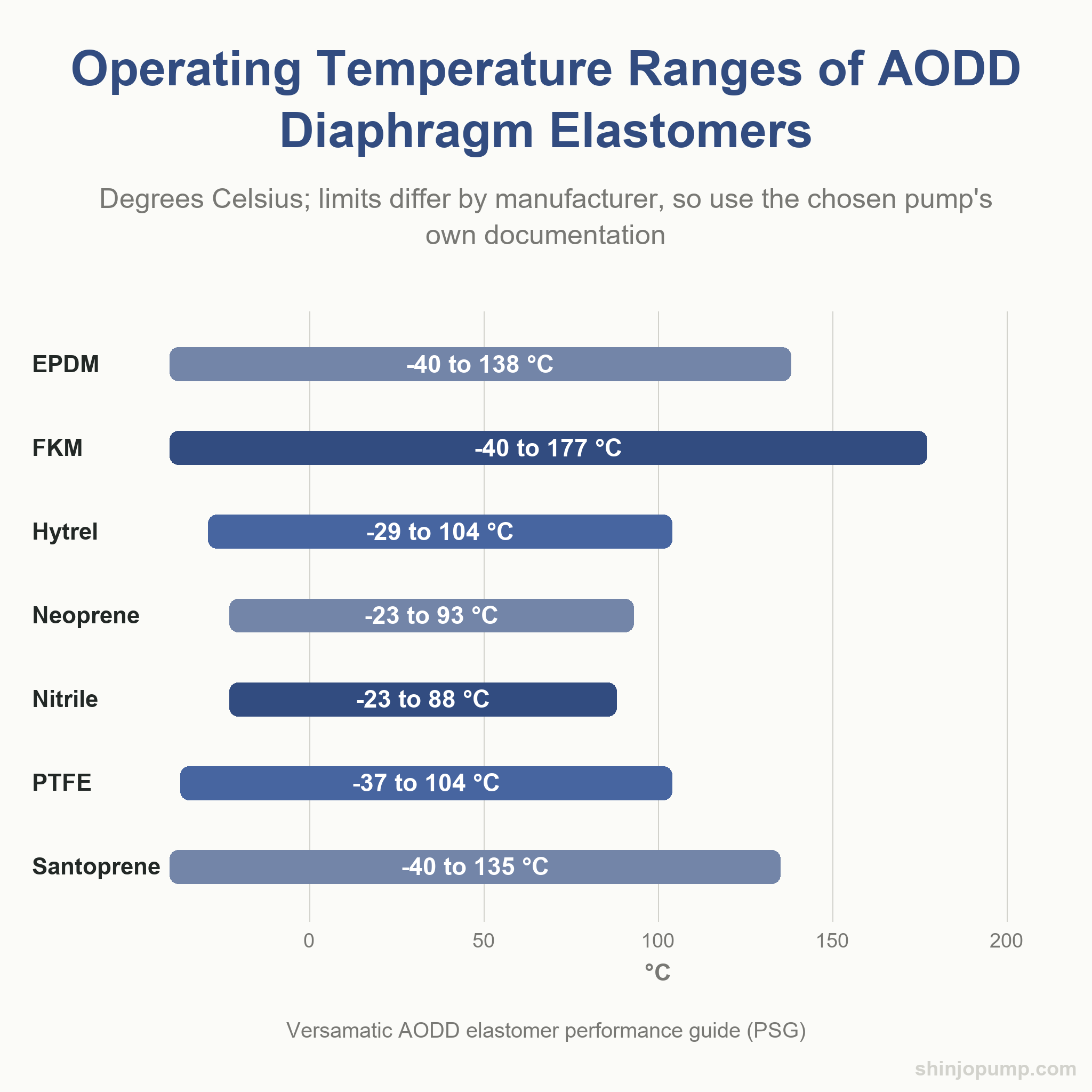
Yamada, publishing the same material families, lists different maximums: Buna N (nitrile, NBR) 82 °C (180 °F), Neoprene 82 °C (180 °F), Santoprene 82 °C (180 °F), EPDM 100 °C (212 °F), PTFE 100 °C (212 °F), Hytrel 120 °C (248 °F), and Viton 120 °C (248 °F) (Yamada Pump, n.d.-a). The two lists differ by 4 to 57 °C on the same material families, and not always in the same direction: Yamada rates Hytrel higher than Versamatic does. The limit that applies to a purchase is the one in that pump's own documentation, not a generic table.
Chemical compatibility for a pneumatic diaphragm pump is checked wetted part by wetted part: the housing, the diaphragms, the check-valve balls and seats, and any O-rings, each against the manufacturer's own compatibility guide. Versamatic notes that when a diaphragm fails, the pumped product reaches the center section and the air valve (Versamatic, n.d.-b).
Shinjo lists QBY3 diaphragms in NBR, Neoprene, EPDM, PTFE, Viton and others; its QBY catalog adds F46-lined designs.
PTFE earns an A+ for chemical resistance and is often specified for aggressive acids, solvents, and food-grade duty. In Versamatic's grading it also carries a C- flex-life score and an F for abrasion, the lowest in the table (Versamatic, n.d.-b). That is the elastomer trade-off in numbers: chemical resistance at the cost of flex life and abrasion resistance. On an abrasive slurry, or on a high-cycle duty with many strokes per minute, a PTFE diaphragm reaches its replacement interval sooner than a Santoprene or Hytrel one at the same conditions. The right question is not which elastomer is strongest overall, but which one survives this fluid at this temperature and this cycle rate.
An AODD pump has no electric motor, but that removes only one ignition source. The pneumatic diaphragm pump still moves flammable liquid past ball valves, cycles diaphragms thousands of times per hour, and vents air through an exhaust that can build a static charge. Air drive is not, by itself, ATEX compliance.
In the European Union, equipment for potentially explosive atmospheres falls under Directive 2014/34/EU (ATEX). The European Commission publishes the harmonized standards that give presumption of conformity; for non-electrical equipment such as AODD pumps these include EN ISO 80079-36 (basic method and requirements) and EN ISO 80079-37 (constructional safety, control of ignition sources, liquid immersion) (European Commission, n.d.).
ATEX conformity is not a single stamp on the casting. AxFlow notes that the directive applies to the pump materials, the air valve assembly, and any ancillaries used in the hazardous area (solenoids, sensors, grounding hardware) (AxFlow, n.d.).
Static is the ignition source air drive still has to control. Versamatic states that ATEX-compliant AODD pumps are suitable for explosive atmospheres only when they are properly grounded per local electrical codes (Versamatic, n.d.-a). Bonding is not partial. The Blagdon/Sandpiper N50 manual requires that the pump, piping, valves, containers and any other equipment in the fluid path be earthed, and the exhaust must not be placed less than 100 mm from any non-conductive surface, because that can generate a propagating brush discharge (Sandpiper Pump, n.d.-b).
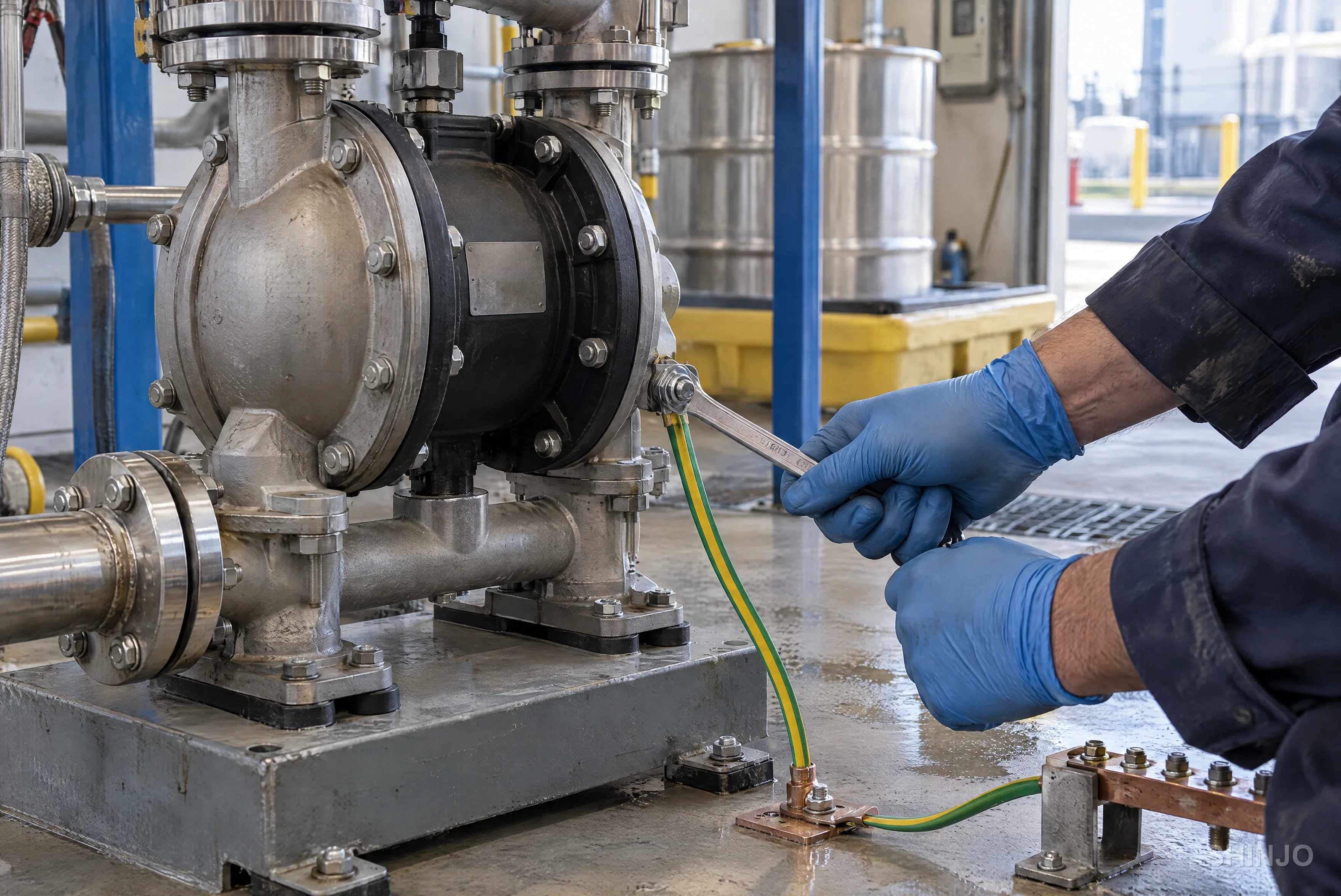
Confirm each of the following before a pneumatic diaphragm pump enters a classified area:
- The zone classification (Zone 0, 1 or 2 for gases; 20, 21 or 22 for dusts) appears in the specification.
- The pump body, wetted materials and diaphragm elastomers are stated as suitable for that zone and the fluid.
- Every ancillary in the hazardous area (solenoid, sensor, filter-regulator, grounding strap) carries its own Ex marking.
- Bonding to a common ground bar is planned for the pump, piping and vessels, with the exhaust routed clear of non-conductive surfaces.
- Ask the supplier, Shinjo included, for the Ex marking and the EU declaration of conformity for that exact model and material build.
The disadvantages of AODD pumps that matter at specification are energy, pulsating flow, the 1:1 pressure ceiling, and diaphragm wear on high-cycle duty. Compressed air is an expensive way to deliver pump power, and Graco states energy consumption can be reduced by up to 5x with an electric diaphragm pump compared with an air-operated one (Graco, n.d.).
A 2025 experimental study of an industrial compressed-air system cut average power consumption by 32.6% by eliminating a 0.54-bar pressure drop, reducing the compressor setpoint from 7.0 to 6.5 bar, and repairing leaks (Zaim, 2025). A 2-inch pump running continuously at 80 scfm illustrates the running cost: about $8,000 a year uncontrolled versus about $800 a year with batch control at the same duty.
Pulsation is the second limit. Downstream instruments, filters and metering steps can be sensitive to it, and a dampener adds cost, space and another component to maintain. The 1:1 rule is the third: a standard pneumatic diaphragm pump can give no more discharge pressure at its outlet than the air pressure at its inlet, so any duty above that ceiling points to a 2:1 design or a different pump technology. High-cycle service is the fourth, because every stroke works the diaphragm, and continuous high-hour transfer shortens its life.
The strengths of a pneumatic diaphragm pump still stand on the duties it was designed for: it self-primes, tolerates a dry line for a limited time, handles solids and shear-sensitive liquids, and needs no electricity at the point of use (Graco, n.d.).
| Duty | AODD pump | Electric diaphragm | Centrifugal |
|---|---|---|---|
| Continuous high-hour transfer | Poor | Good | Good |
| Intermittent or portable transfer | Good | Acceptable | Poor |
| No power at the point of use | Good | Poor | Poor |
| Solids, slurry or shear-sensitive liquids | Good | Good | Poor |
| Low viscosity, steady flow at high head | Poor | Acceptable | Good |
| Tight flow control or metering | Poor | Good | Acceptable |
Where an electric replacement fits the same envelope, Shinjo's DBY motor-driven diaphragm pump shares the QBY3 series' hydraulic performance and only the drive differs. Where a centrifugal is the better fit, see how to select a centrifugal pump.
A disciplined data sheet lets buyers compare air-operated and motor-driven diaphragm pump models on equal footing.
A request for quotation for a pneumatic diaphragm pump should state 13 fields: the liquid, temperature, viscosity, solids, flow range, discharge pressure, suction arrangement, air available at the pump, duty cycle, hazardous-area class, connections, materials and documents. Air pressure and SCFM at the pump matter most, because together they cap both flow and discharge pressure.
| Field | What to state | Why it matters |
|---|---|---|
| Liquid and concentration | Chemical name, percent by weight | Sets wetted-part compatibility |
| Temperature range | Normal and maximum in °C (°F) | Caps elastomer choice |
| Viscosity and specific gravity | cP and SG at duty temperature | Sets stroke rate and head conversion |
| Solids | Size (mm), percent by volume, abrasive or not | Sets valve type and housing wear |
| Flow range | L/min and US gpm | Locates the duty on the curve |
| Discharge pressure or head | Normal and maximum, in bar | Sits below the air pressure per the 1:1 rule |
| Suction arrangement | Flooded or lift, line length and size | Sets priming and dry-lift margin |
| Air available at the pump | Pressure (bar) and volume (SCFM) | Caps flow and discharge pressure |
| Duty cycle | Hours per day, continuous or batch | Drives running cost and diaphragm wear |
| Hazardous-area class | Zone and gas group, or none | Selects Ex marking and grounding |
| Connections | Standard and size (DN, NPT, BSP) | Ensures pipe and flange fit |
| Materials | Housing, diaphragms, balls and seats | Chemistry and flex life |
| Required documents | Curve, datasheet, DoC, Ex marking | Basis for audit and approval |
An AODD pump's discharge pulses. The amount of pulsation depends on pump size, speed, air supply pressure, discharge pressure, fluid viscosity, piping and distance to downstream equipment (Yamada Pump, n.d.-b); a pulsation dampener is matched to the pump model and port size, flow rate, discharge pressure, viscosity and chemical compatibility (Yamada Pump, n.d.-b). State in the RFQ whether the downstream meter, filler, spray head or filter can accept pulsating flow, or whether a pulsation dampener belongs in the scope of supply.
A pneumatic diaphragm pump, also called an AODD pump, is a positive displacement pump driven by compressed air. An air valve shifts two diaphragms joined by a shaft, so one chamber discharges while the other fills, and four check valves keep the liquid moving one way.
Air-operated (AODD) pumps need compressed air; the air side is what drives the diaphragms and sets the flow. Electric (motor-driven) diaphragm pumps do not need compressed air, since a motor and gearbox move the diaphragms instead. The choice between the two is a duty decision, not a technology preference.
The disadvantages that matter at specification are the energy cost of compressed air, pulsating discharge flow, the 1:1 pressure ceiling that caps discharge at the air pressure supplied, and diaphragm wear on high-cycle continuous duty. Each is a duty question, not a defect in the pump.
Yes. An AODD pump can evacuate air from the suction line and prime itself. Wetting the pump before start-up improves priming markedly, because a wet stroke seats the check balls better than a dry one. Dry suction lift is lower than wet suction lift on the same pump.
A generic 2-inch AODD pump uses 90 to 120 scfm at an average 95 psig inlet (Van Ormer, n.d.). Air use rises with flow and discharge pressure and falls with viscosity and back pressure. Size the compressor with hp = SCFM / 4.5 (PSG Blackmer, 2022), then round up to the next 5 hp step.
Standard 1:1 ratio AODD pumps are rated to 125 psi (8.6 bar) (Versamatic, n.d.-a). Fit a filter-regulator upstream where the plant air could exceed that ceiling. Discharge pressure cannot exceed the air pressure applied at the inlet, so the air supply is what caps the achievable duty.
Read the manufacturer's performance curve at your duty. Draw a horizontal line from the discharge pressure and a vertical line from the required flow; their intersection sits on one air-inlet-pressure curve and near one air-consumption line, giving the SCFM the pump will draw and the compressor it needs.
Yes, briefly. An AODD pump tolerates dry running because it has no shaft seals or close-clearance rotating parts. Sustained dry running still wears the diaphragms and wastes air, so treat it as an occasional condition when the tank empties, not as a normal operating point.
A pneumatic diaphragm pump is specified from the air side, and the rest of the datasheet follows from that read. The duty converts to bar first, then the curve is read at the flow and discharge pressure to fix the inlet air pressure and the SCFM the pump will draw. The compressor and the air line must be able to deliver that flow at the required inlet pressure at the pump, not at the header. The reading is derated for suction lift, viscosity and solids, using the manufacturer's correction where one is published and asking for it where it is not.
Elastomers are chosen from the pump's own temperature limits and its wetted-parts compatibility guide, because manufacturers publish different figures for the same material family. Hazardous-area service and continuous high-hour duty are separate decisions: an AODD pump in a classified zone needs its Ex marking and grounding, and long running hours often justify an electric diaphragm pump.
- Zaim, A. (2025). Industrial compressed air system optimization: Experimental evaluation of energy efficiency and sustainability gains. Processes, 13(11), 3590. https://doi.org/10.3390/pr13113590
- European Commission. (n.d.). Equipment for explosive atmospheres (ATEX): Directive 2014/34/EU. Retrieved September 19, 2026, from https://single-market-economy.ec.europa.eu/single-market/european-standards/harmonised-standards/equipment-explosive-atmospheres-atex_en
- U.S. Energy Information Administration. (2026). Average retail price of electricity to ultimate customers by end-use sector: Industrial, June 2026 [Data set]. https://www.eia.gov/electricity/data/browser/#/topic/7?agg=0,1&geo=g&freq=M
- PSG Blackmer. (2022, October 27). How understanding AODD pump performance curves optimizes operations. https://www.psgdover.com/blackmer/news/article/2022/10/27/how-understanding-aodd-pump-performance-curves-optimizes-operations
- All-Flo Pump. (n.d.). With minimized compressed air usage, AODDPs provide an energy-efficient solution. Pumps & Systems. Retrieved September 19, 2026, from https://www.pumpsandsystems.com/article/minimized-compressed-air-usage-aoddps-provide-energy-efficient-solution
- Global Pumps. (n.d.). Reading an air-operated double-diaphragm pump performance curve. Retrieved September 19, 2026, from https://www.globalpumps.com/blog/reading-an-air-operated-double-diaphragm-pump-performance-curve
- Yamada Pump. (n.d.-a). What is a diaphragm? AODD pump diaphragm materials. Retrieved September 19, 2026, from https://www.yamadapump.com/what-is-a-diaphragm
- Yamada Pump. (n.d.-b). What is a pulsation dampener? AODD pump flow & pressure control. Retrieved September 19, 2026, from https://www.yamadapump.com/what-is-a-pulsation-dampener
- Versamatic. (n.d.-a). Key AODD pump performance specifications explained. Retrieved September 19, 2026, from https://www.versamatic.com/blog/key-aodd-pump-performance-specifications-explained
- Versamatic. (n.d.-b). Your guide to AODD pump elastomer material performance properties. Retrieved September 19, 2026, from https://www.versamatic.com/blog/your-guide-to-aodd-pump-elastomer-material-performance-properties
- Van Ormer, H. (n.d.). Missed demand-side opportunities part 6: Look to AODD pumps to lower compressed air demand. Compressed Air Best Practices. Retrieved September 19, 2026, from https://www.airbestpractices.com/system-assessments/end-uses/missed-demand-side-opportunities-part-6-look-aodd-pumps-lower-compressed
- Sandpiper Pump. (n.d.-a). Flap valve vs. ball valve AODD pumps: Understand which is right for your application. Retrieved September 19, 2026, from https://www.sandpiperpump.com/blog/flap-valve-vs.-ball-valve-aodd-pumps-understand-which-is-right-for-your-application
- Sandpiper Pump. (n.d.-b). N50 & X50 hygienic B5002 series service and operating manual. Retrieved September 19, 2026, from https://www.sandpiperpump.com/hubfs/N50_X50_Hygienic.pdf
- AxFlow. (n.d.). ATEX AODD pumps. Retrieved September 19, 2026, from https://www.axflow.com/en-gb/applications/technical-support/pump-technologies/certificates-and-approvals/atex/atex-aodd-pumps
- Graco. (n.d.). How does a diaphragm pump work and what is it used for? Benefits of an electric diaphragm pump. Retrieved September 19, 2026, from https://www.graco.com/us/en/in-plant-manufacturing/solutions/articles/benefits-of-an-electric-diaphragm-pump.html
Last reviewed and updated: September 2026. Author: Shinjo Pump engineering team. For pump selection support or a quotation on your duty point, contact our team.
