

- Oct 27, 2026
- Hits: 0
A sewage pump moves raw wastewater that carries solids and fibers. Its defining specification is solids passage: the largest sphere it can pass. In buildings, the 2025 Plumbing Code of New York State (section 712.4.2), based on the International Plumbing Code, requires a non-grinder pump that receives toilet discharge to handle spherical solids up to 2 in (51 mm) (International Code Council & New York State Department of State, 2025). In municipal stations, the 2014 edition of the Recommended Standards for Wastewater Facilities (Ten States Standards, section 42.33) asks pumps handling raw wastewater to pass solid spheres of at least 80 mm (3 in) (Great Lakes-Upper Mississippi River Board, 2014). Flow and head decide the duty point; solids passage decides whether the pump keeps running.
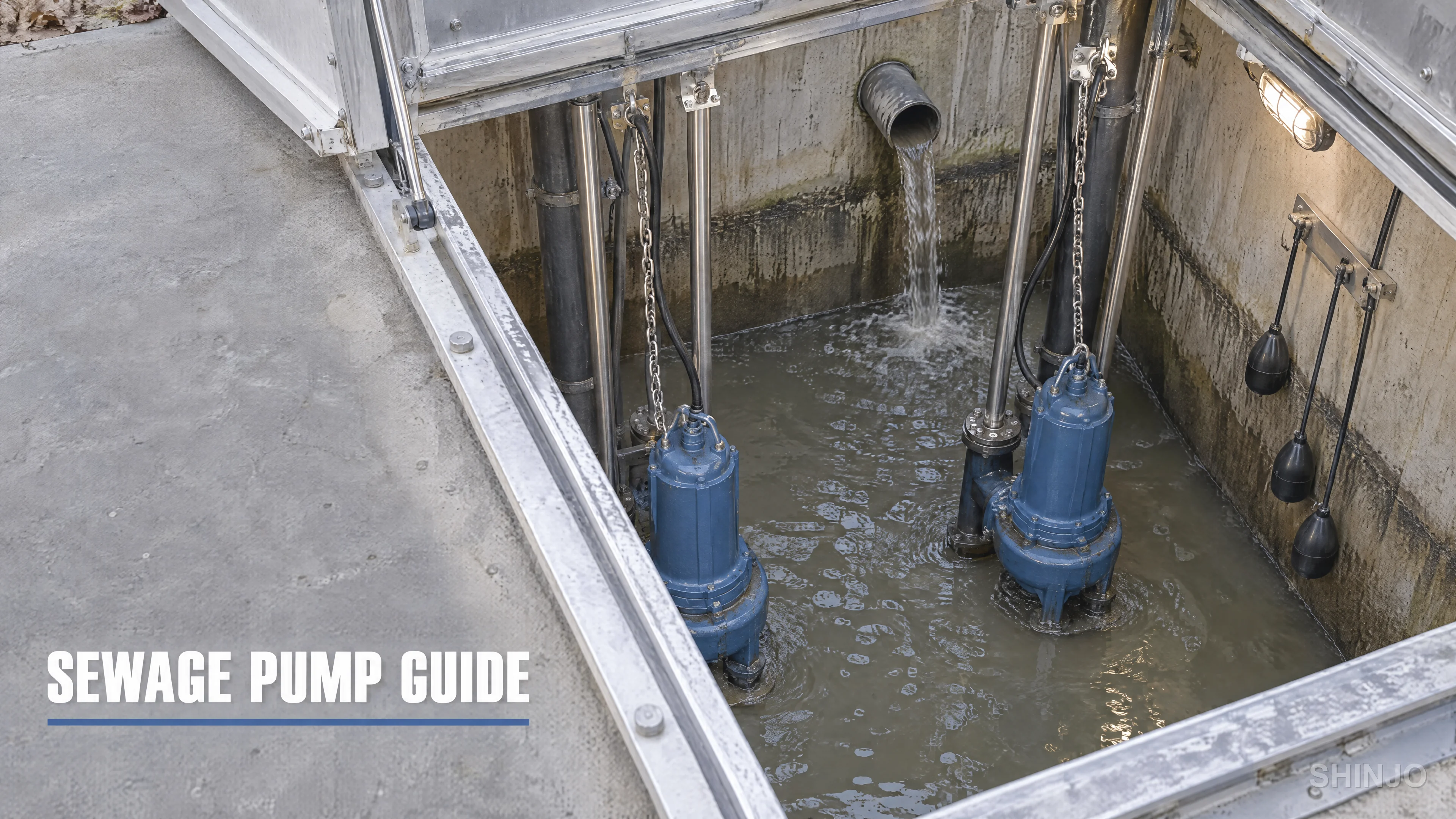
This guide is for procurement, project and utility engineers who specify or buy pumps and pump stations. It sets out the pump types and where each fits, the parts and controls of a sewage pump system, and a worked sizing example. It also explains pressure sewers, seals and motor protection, failure causes, and what a quote request must state. Homeowners get a short answer and a clear line where residential practice ends.
- Solids passage defines the pump: 51 mm (2 in) for toilet discharge; 80 mm (3 in) in Ten States 2014.
- Size for firm capacity: with any pump out of service, the remaining pumps carry design peak hourly flow.
- Keep force-main velocity in range: at design pumping rates, 0.6 m/s minimum and 2.4 m/s recommended maximum (2-8 ft/s).
- Illustrative worked example: 31.4 L/s (498 gpm) at 28.1 m (92 ft) TDH through 600 m of DN150 force main.
- Wet-well volume: V = T x Q / 4, where cycle time T comes from the pump maker's starts-per-hour limit.
- Pressure sewers fit where gravity costs too much: low housing density, flat ground with high groundwater or bedrock, uphill outfalls.
- Wipes clog sewage pumps: NACWA estimates they add about $441 million a year to US collection-system operating costs (2019 data).
- Abstract
- Key Takeaways
- What a sewage pump is and the solids it must pass
- Types of sewage pump and where each fits
- The sewage pump system inside a lift station
- By the Numbers
- Sizing a sewage pump station: a worked example
- Pump sewer system: when pressure sewers replace gravity
- Motors, seals and protection on a submersible unit
- Why sewage pumps clog, air-lock and short-cycle
- Buying a sewage pump: what the inquiry should state
- Frequently Asked Questions
- Conclusion
- References
A sewage pump, in KSB's definition, transports sewage and untreated wastewater, mainly in municipal treatment plants but also in buildings and private homes that cannot drain to the sewer by gravity (KSB, n.d.). Some shopping listings call the same machine a sewage water pump.
SSPMA trade classes, as Goulds/Xylem presents them, sort these pumps by solids size. Sump pumps handle clear water with solids up to 1/2 in (Rook, n.d.). Effluent pumps handle solids up to 1 in, in partly or fully treated wastewater leaving a septic tank or treatment plant (Rook, n.d.). Sewage pumps start at 1-1/2 in, with the note that most codes say 2 in, and handle household wastewater that may contain human waste (Rook, n.d.).
Effluent and sewage duties differ. In a septic tank, solids settle as sludge and the liquid effluent flows on to the drainfield (U.S. Environmental Protection Agency, 2026). An effluent pump moves that settled liquid; an ejector takes raw sewage straight from the toilet. A grinder pump cuts solids for high-head discharge through small pipe (Rook, n.d.).
The 2025 Plumbing Code of New York State, built on the International Plumbing Code, states solids passage as a sphere: 13 mm (1/2 in) for other pumps or ejectors (International Code Council & New York State Department of State, 2025), and more once a toilet discharges to the pump.
| Pump or duty | Solids it must pass | Source |
|---|---|---|
| Sump pump, clear water | Up to 1/2 in | SSPMA class (Rook, n.d.) |
| Effluent pump, settled effluent | Up to 1 in | SSPMA class (Rook, n.d.) |
| Sewage pump or ejector receiving toilet discharge | Spheres up to and including 51 mm (2 in) | 2025 NY Plumbing Code, §712.4.2 (International Code Council & New York State Department of State, 2025) |
| Building lifting plant, fecal wastewater | Free passage of at least 40 mm | EN 12050-1, as DAB Pumps summarizes it |
| Raw-wastewater pumping station | Spheres of at least 80 mm (3 in); openings at least 100 mm (4 in) | 2014 edition of the Ten States Standards, §42.33 (Great Lakes-Upper Mississippi River Board, 2014) |
| Grinder pump or ejector receiving toilet discharge | Exempt from the sphere rule; discharge opening at least 32 mm (1-1/4 in) | 2025 NY Plumbing Code, §712.4.2 exception (International Code Council & New York State Department of State, 2025) |
Goulds/Xylem draws the residential line at 2 in solids; typical municipal and commercial stations pass 3 in or more (Rook, n.d.). The 2014 edition of the Ten States Standards allows case-by-case exceptions to section 42.33 where the design gives equivalent protection from clogging, and it names grinder pumps as an example (Great Lakes-Upper Mississippi River Board, 2014). The Minnesota Department of Health now lists a 2026 edition of the Recommended Standards for Wastewater Facilities (Ten States Standards) as current and the 2014 edition as archived. Check the edition your state adopts.
Section 712.4.2 of the 2025 Plumbing Code of New York State requires a sewage pump or ejector receiving toilet discharge to handle spheres up to and including 51 mm (2 in) (International Code Council & New York State Department of State, 2025). For pumps handling raw wastewater, section 42.33 of the 2014 edition of the Ten States Standards sets a minimum sphere diameter of 80 mm (3 in) (Great Lakes-Upper Mississippi River Board, 2014).
The US EPA's 2000 lift-station fact sheet, EPA 832-F-00-073, names dry-well and submersible as the two most common lift-station types (U.S. Environmental Protection Agency, 2000). Submersible pumps are lifted out and reinstalled on guide rails with a hoist (U.S. Environmental Protection Agency, 2000). Dry-well stations allow easy inspection and are generally easier to repair (U.S. Environmental Protection Agency, 2000), while submersible stations typically cost less and run without frequent pump maintenance (U.S. Environmental Protection Agency, 2000).
| Type | Where it sits | Where it fits | What to watch |
|---|---|---|---|
| Submersible on guide rail | Wet-well floor, under the liquid | Permanent stations; typically lower cost (U.S. Environmental Protection Agency, 2000) | Surface-cooled motors must stay submerged |
| Dry-pit | Dry room next to the sump | Inspection and repair access (U.S. Environmental Protection Agency, 2000) | Motor cooling (a jacket) |
| Vertical (column) submersible | Upright in the sump | Within its listed temperature and density limits | Seal design |
| Self-priming, above ground | Above the liquid | Shallow pits; the pump stays dry | Suction lift (2014 Ten States, section 43.11) (Great Lakes-Upper Mississippi River Board, 2014) |
| Sewage transfer pump | Portable, at the job | Tank-to-tank transfer, tanker unloading, station bypass | Solids size and priming lift |
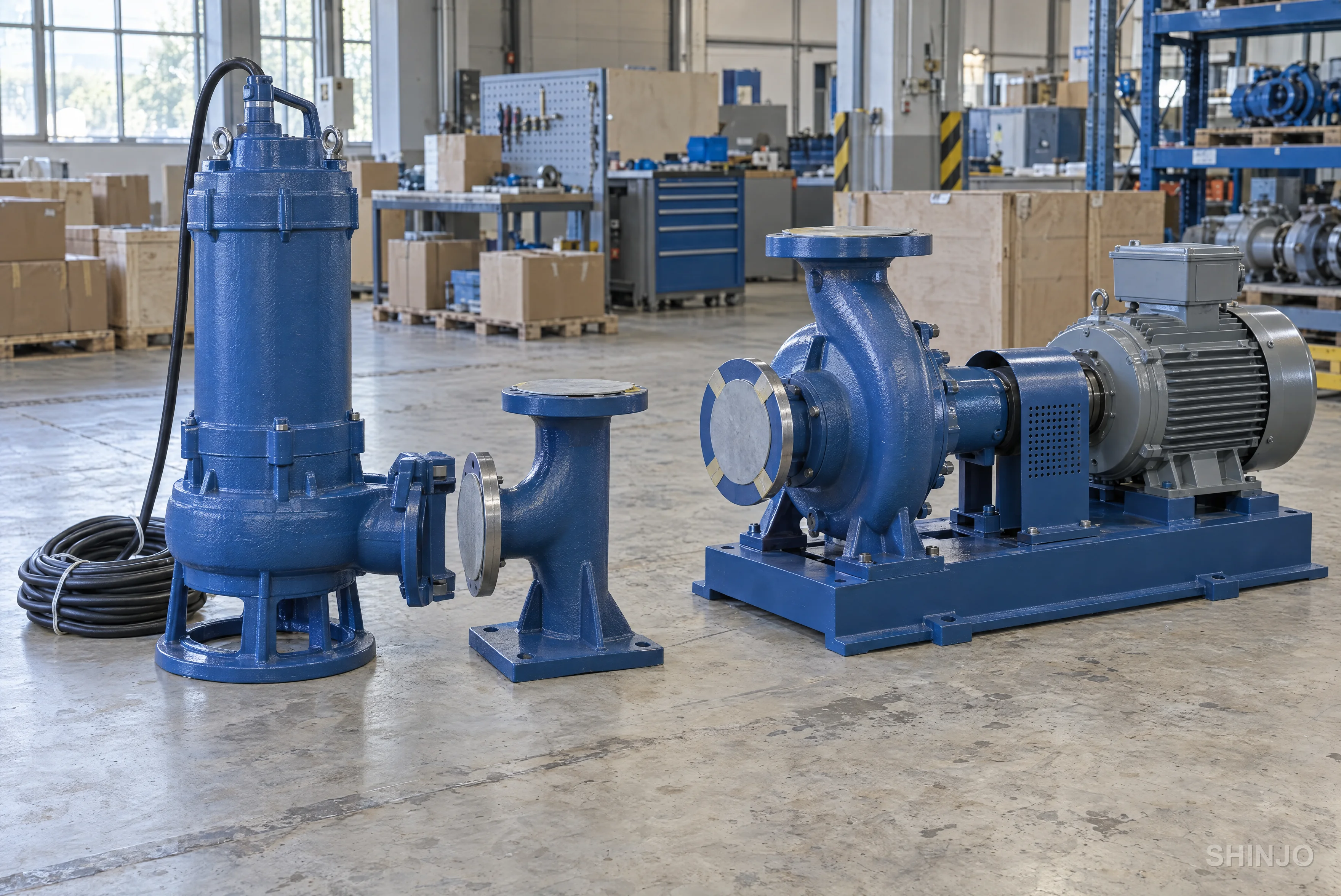
Wilo describes the submersible wastewater pump, the trade's other name for a submersible sewage pump, as close-coupled with a sealed motor. A surface-cooled motor sheds heat into the surrounding liquid, which works as long as the pump stays fully submerged; jacket-cooled designs keep cooling at low levels or in dry conditions. Shinjo rates its WQ series for liquids from 0 to 55 °C (32 to 131 °F).
As Grundfos explains, a dry-pit pump sits beside the sump, and its motor needs cooling from a jacket carrying an external liquid or the pumped liquid. Grundfos describes a trend toward dry installation, mainly because of the working environment for servicing the pumps. EPA's 2000 fact sheet described the opposite trend for small and medium stations (typically below 24,000 L/min, or 6,350 gpm): replacing dry-well stations with submersible ones, mainly because of lower cost, a smaller footprint and simpler operation and maintenance (U.S. Environmental Protection Agency, 2000). Both can hold: submersible stations save cost and space, while a dry pit gives crews a better place to service the pumps.
Shinjo lists its YW vertical submersible sewage pump for 0 to 80 °C (32 to 176 °F), a wider window than the WQ's, and specific gravity up to 1.5, with a double mechanical seal.
The 2014 edition of the Ten States Standards required suction-lift pumps to be self-priming or vacuum-priming (section 43.1) (Great Lakes-Upper Mississippi River Board, 2014). Section 43.11 limited self-priming suction piping to 7.6 m (25 ft) in length (Great Lakes-Upper Mississippi River Board, 2014) and capped dynamic suction lift at pump-off plus the required net positive suction head (NPSHR) at 6.7 m (22 ft) (Great Lakes-Upper Mississippi River Board, 2014). Shinjo's ZW self-priming non-clogging sewage pump needs no foot valve and is rated to 80 °C (176 °F); it comes in cast iron or stainless steel.
For a given pit, Shinjo's self-priming vs submersible sewage pump guide works through the choice, starting from suction lift. The impeller is a separate choice: KSB's pump lexicon names single-vane and channel impellers alongside free-flow (torque-flow) and diagonal designs (KSB, n.d.), and Shinjo's non-clogging pump guide sets out their trade-offs.
The trade gives the name sewage transfer pump to portable self-priming trash, shredder or dry-priming pumps on temporary jobs such as tanker unloading or station bypass. Xylem states that its Godwin Dri-Prime range moves raw sewage with solids up to 125 mm (4.9 in) and primes automatically from dry to 8.5 m (28 ft) of suction lift; the pumps can also run dry. That is one range's priming capability, separate from the 6.7 m (22 ft) limit section 43.11 set for permanent stations (Great Lakes-Upper Mississippi River Board, 2014). The 2014 text also listed portable pumping equipment as one way to provide emergency pumping (section 47.2) (Great Lakes-Upper Mississippi River Board, 2014).
A lift station is a sewage pump system at municipal scale: inflow collects in a wet well, pumps lift it, valves stop backflow and a force main carries it away. US EPA's 2000 fact sheet puts lift-station capacities at 76 L/min (20 gpm) to more than 378,500 L/min (100,000 gpm) (U.S. Environmental Protection Agency, 2000). Centrifugal pumps are commonly used (U.S. Environmental Protection Agency, 2000).
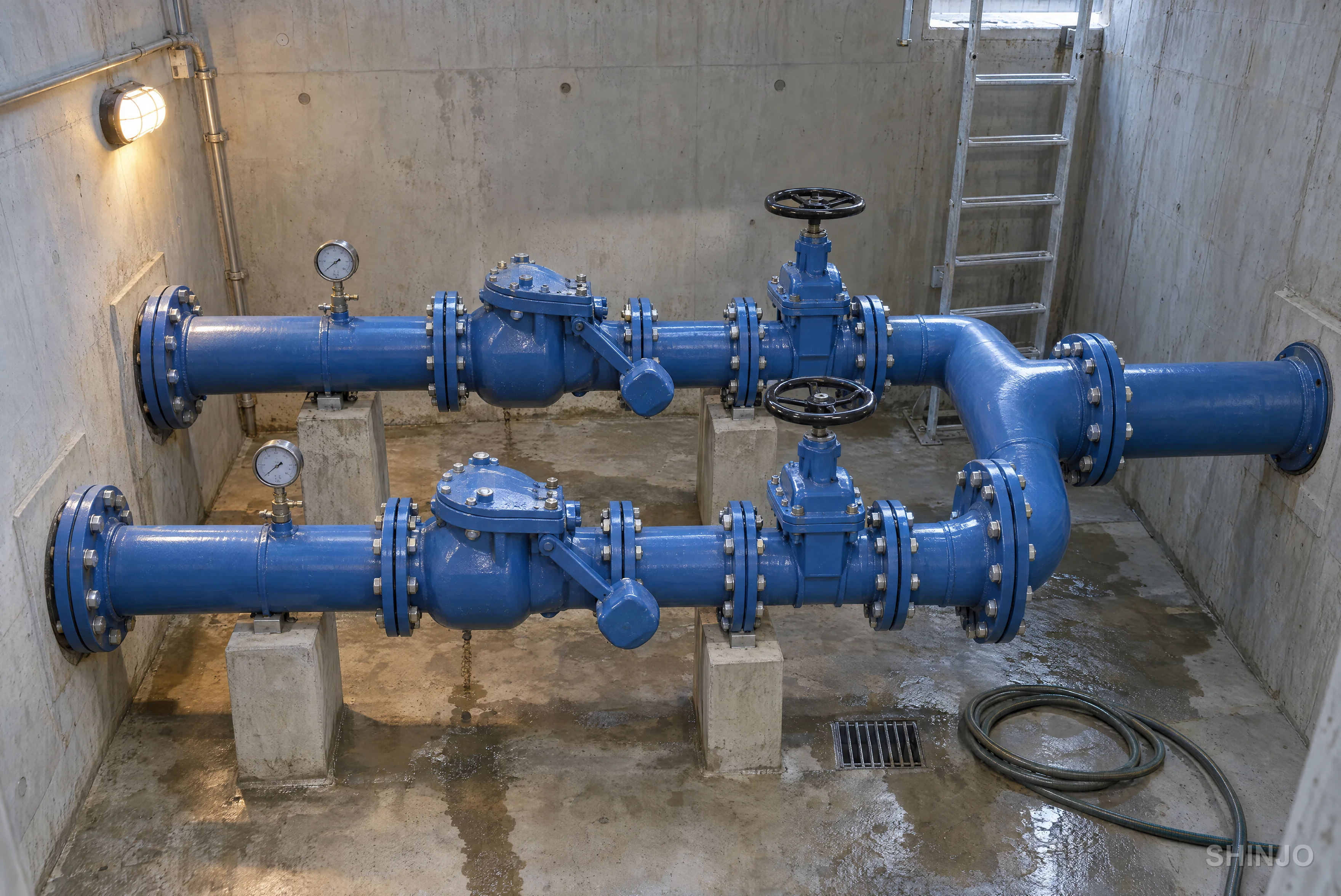
Per EPA, a wet well must be large enough to prevent rapid pump cycling and small enough to prevent long detention and odor release (U.S. Environmental Protection Agency, 2000).
Typical maximum detention is 20 to 30 minutes with constant-speed pumps and 5 to 15 minutes with variable-frequency drives (U.S. Environmental Protection Agency, 2000).
Submersible sewage pumps are periodically lifted to the surface and reinstalled on guide rails with a hoist (U.S. Environmental Protection Agency, 2000). The 2014 edition of the Ten States Standards (section 42.31) calls for multiple pumps, equal in size where only two are installed, so that with any unit out of service the rest still handle the design peak hourly flow (Great Lakes-Upper Mississippi River Board, 2014). That clause underlies firm capacity, a term the 2014 text does not use (Great Lakes-Upper Mississippi River Board, 2014).
Under section 42.52, each sewage pump (screw pumps excepted) discharges through a shutoff valve and a check valve, the check valve nearer the pump (Great Lakes-Upper Mississippi River Board, 2014). The same section puts check valves on horizontal discharge piping, though ball checks may sit in the vertical run (Great Lakes-Upper Mississippi River Board, 2014). The pump lines then join the force main.
EPA lists bubblers, electrodes, floats and mercury switches as level controls, with variable-speed drives for more sophisticated control (U.S. Environmental Protection Agency, 2000). The 2014 Ten States text (section 42.4) places level sensors away from turbulent inflow and pump suction (Great Lakes-Upper Mississippi River Board, 2014). It also asks for dual air compressors on bubbler systems and automatic alternation of the sewage pumps (Great Lakes-Upper Mississippi River Board, 2014).
Section 46 (2014 edition) calls for alarms with a backup power source, activated by power failure, high water in the wet well or dry-well sump, pump failure, unauthorized entry or other malfunction (Great Lakes-Upper Mississippi River Board, 2014). Section 47.2 requires emergency pumping unless storage prevents overflow, using two independent utility substations, an engine generator, an engine pump or portable pumping equipment (Great Lakes-Upper Mississippi River Board, 2014).
EPA notes that variable-speed pumps can work with a smaller wet well and hold a near-constant level with fewer starts and stops (U.S. Environmental Protection Agency, 2000). Energy savings can be significant where friction losses are large, yet the drive may not justify its added capital cost unless power is expensive (U.S. Environmental Protection Agency, 2000).
A 2026 systematic review of 29 peer-reviewed studies on optimizing the operation of sewage pumping stations reports energy reductions of about 3-4% from minor control refinements and about 15-32% in studies using predictive scheduling or optimization (Guimarães et al., 2026). The review finds variable frequency drives widen the control options but yield no benefit without a control policy; most results come from simulations or short pilots (Guimarães et al., 2026).
Section 42.75 of the 2014 edition calls for mechanical wet-well ventilation with 100% fresh air: at least 12 air changes per hour if continuous, or 30 if intermittent (Great Lakes-Upper Mississippi River Board, 2014). Section 42.35 puts electrical equipment in raw-wastewater wet wells under National Electrical Code Class I, Division 1, Group D (Great Lakes-Upper Mississippi River Board, 2014). NFPA 820, whose current edition is 2024, sets requirements for protection against fire and explosion hazards in wastewater treatment and collection facilities, and EPA's 2000 fact sheet cites it for fitting continuous ventilation systems with flow detection devices connected to alarms (U.S. Environmental Protection Agency, 2000).
EPA calls minimizing wet-well turbulence a simple, widely used odor control; scrubbers or biofilters work better, as do chemicals added upstream (U.S. Environmental Protection Agency, 2000). EPA's 1991 report to Congress traces hydrogen sulfide corrosion to acid attack, after biological conversion of the gas to sulfuric acid, and to direct attack on copper, iron, steel and electrical contacts.
Solids passage first, then flow and head. When a project has its design flow, the total dynamic head at the low wet-well level and the largest sphere the pump must pass, put those figures in writing: the Sewage Pumps range is quoted against the duty point you state, which lets you check the offer against your own datasheet.
- 12 per hour minimum continuous wet-well air changes, Ten States 2014 (Great Lakes-Upper Mississippi River Board, 2014)
- 20 to 30 min typical maximum detention with constant-speed pumps, EPA 2000 (U.S. Environmental Protection Agency, 2000)
- 5 to 15 min typical maximum detention with variable-frequency drives, EPA 2000 (U.S. Environmental Protection Agency, 2000)
- 76 L/min (20 gpm), low end of EPA's lift-station capacity range (U.S. Environmental Protection Agency, 2000)
Sizing a duplex sewage pump station rests on peak hourly flow, total dynamic head at the low wet-well level, and active wet-well volume. Take 2,000 people at the 2014 Ten States per-capita design flow (Great Lakes-Upper Mississippi River Board, 2014). With an assumed 12.0 m lift through 600 m of DN150 force main, each pump then needs 31.4 L/s (498 gpm) at 28.1 m (92 ft).
Every input here is an assumption chosen for illustration; the constants and formulas are sourced. Per-capita flow is 100 US gal (380 L) per day, the section 11.243 design value in the 2014 edition of the Ten States Standards (Great Lakes-Upper Mississippi River Board, 2014). The smooth or lined DN150 (6 in) main is taken as 0.150 m bore and 600 m (1,969 ft) long. Static head from pump stop to the discharge high point is 12.0 m (39.4 ft); minor losses total K = 5.0, and sewage is treated as water at 1,000 kg/m3.
Figure 1 of the 2014 edition, credited there to Fair and Geyer, 1954, gives the ratio of peak hourly to average flow (Great Lakes-Upper Mississippi River Board, 2014):
PF = (18 + √P) / (4 + √P), with P the population in thousands.
With P = 2.0, PF = 3.586. Average flow is 8.763 L/s (138.9 gpm); multiplied by PF, peak hourly flow is 31.4 L/s, or 113.1 m3/h (498 gpm).
Two equal sewage pumps, each sized for 31.4 L/s, meet 2014 Ten States §42.31: with one out of service, the other carries peak hourly flow (Great Lakes-Upper Mississippi River Board, 2014). EPA's 2000 lift-station fact sheet calls that layout customary below 2,640 L/min (700 gpm) of maximum inflow (U.S. Environmental Protection Agency, 2000), and 498 gpm qualifies.
Velocity is v = Q / A = 1.78 m/s (5.83 ft/s). That lies between the 0.6 m/s (2 ft/s) cleansing minimum and the 2.4 m/s (8 ft/s) recommended maximum of 2014 Ten States §49.1 (Great Lakes-Upper Mississippi River Board, 2014); DN150 also clears the clause's 100 mm (4 in) minimum diameter for raw wastewater (Great Lakes-Upper Mississippi River Board, 2014).
The 2014 edition's §49.61 sets C = 100 for unlined iron or steel and allows a higher C, not exceeding 120, for smooth or lined pipe (Great Lakes-Upper Mississippi River Board, 2014). Friction follows the SI Hazen-Williams form:
h_f = 10.67 x L x Q^1.852 / (C^1.852 x D^4.8704)
At C = 120 that gives 15.32 m (50.3 ft); a US-unit cross-check agrees within 0.2%. Minor losses, K x v²/2g, are 5.0 x 0.161 = 0.81 m (2.6 ft). The components of pump total head then add up:
TDH = static + friction + minor = 12.0 + 15.32 + 0.81 = 28.1 m (92 ft)
That duty point sits at the low wet-well level; at the start level, static head is smaller and the pump runs further out on its curve. Only friction changes with C:
| Hazen-Williams C | Friction loss | TDH |
|---|---|---|
| 100 (unlined iron or steel) (Great Lakes-Upper Mississippi River Board, 2014) | 21.47 m | 34.3 m |
| 120 (design case) | 15.32 m | 28.1 m |
| 140 (new pipe) | 11.52 m | 24.3 m |
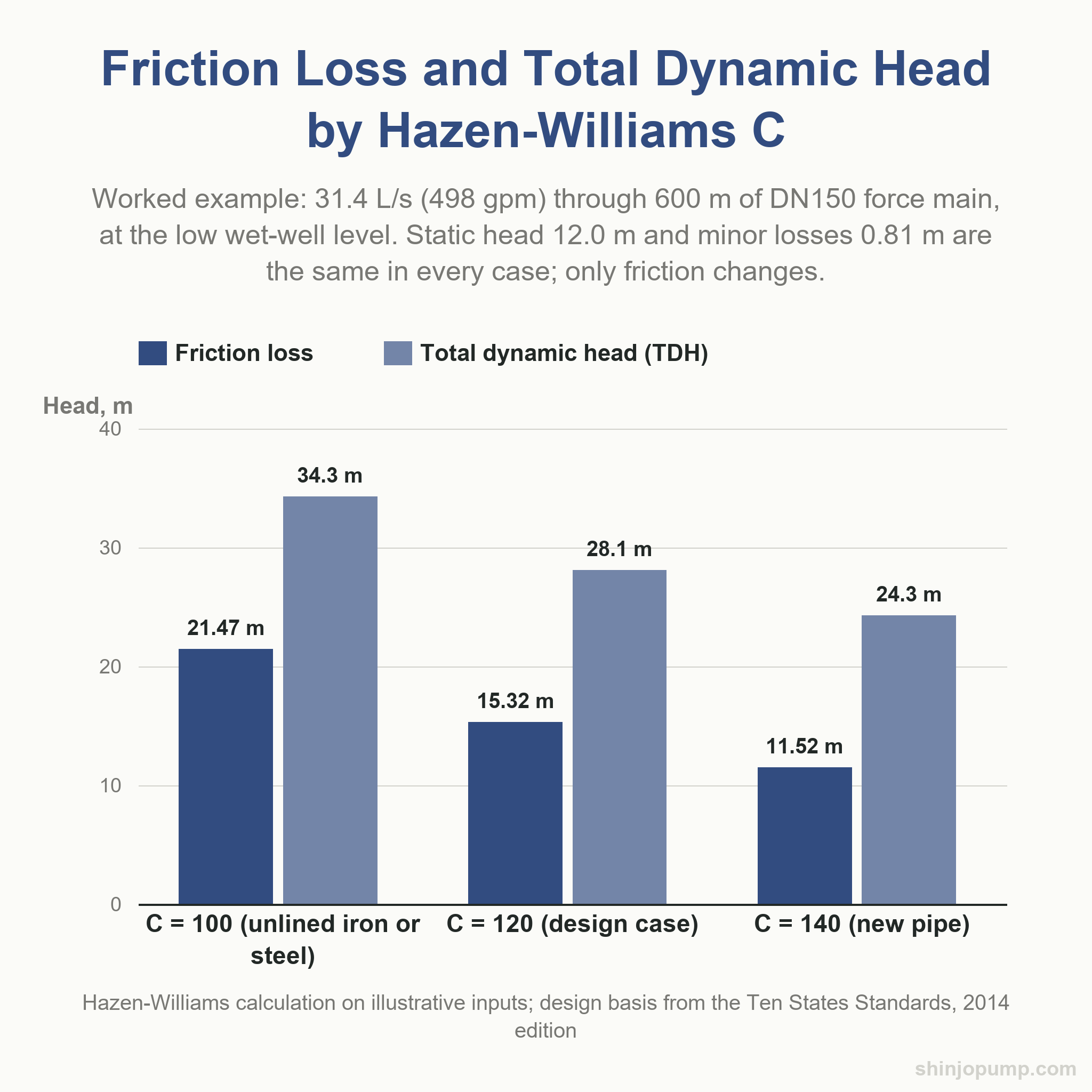
A new, smoother main has a higher C and lowers the system curve: the pump delivers more flow and draws more power. Under 2014 Ten States §49.62, designers consider that effect on maximum power and duty-cycle time to prevent motor damage (Great Lakes-Upper Mississippi River Board, 2014).
At 1,000 kg/m3, hydraulic power P = ρ x g x Q x H is 8.67 kW (11.6 hp); at an assumed 60% pump efficiency, shaft power is 14.4 kW (19.4 hp). That is arithmetic only; the motor follows the pump supplier's curve and service factor.
Flygt's design brochure gives the minimum active (start-to-stop) volume as V = T x Q / 4, with T the minimum cycle time and Q the pump rate. The brochure states that Flygt pumps can make 15 starts per hour without endangering pump life. The 2014 edition's §42.62 sets minimum cycle time from the pump maker's duty-cycle recommendation (Great Lakes-Upper Mississippi River Board, 2014) and caps fill time at 30 minutes at design average flow (Great Lakes-Upper Mississippi River Board, 2014).
Required volume and fill time at average flow:
- 15 starts per hour (T = 4 min): 1.885 m3 (498 US gal), 3.6 min fill
- 10 starts per hour: 2.83 m3 (747 gal), 5.4 min fill
- 6 starts per hour: 4.71 m3 (1,245 gal), 9.0 min fill
All three pass the fill-time check. At T = 4 min the formula reduces to gallons = gpm, hence 498 US gal. Alternating the two pumps each cycle halves each pump's starts, so 1.885 m3 gives each about 7.5 starts per hour at worst-case inflow. Before fixing the volume, get the pump maker's own starts limit and its curve at both the low-level duty point and the C = 140 case.
In municipal engineering, a pump sewer system is a pressure sewer: a pump sewer replaces the deep gravity main with small-diameter pressure pipe fed by pump units on the connected properties (U.S. Environmental Protection Agency, 2002). In a house, the phrase can also mean a basement ejector, a sewage pump lifting the building's sewage to the gravity sewer.
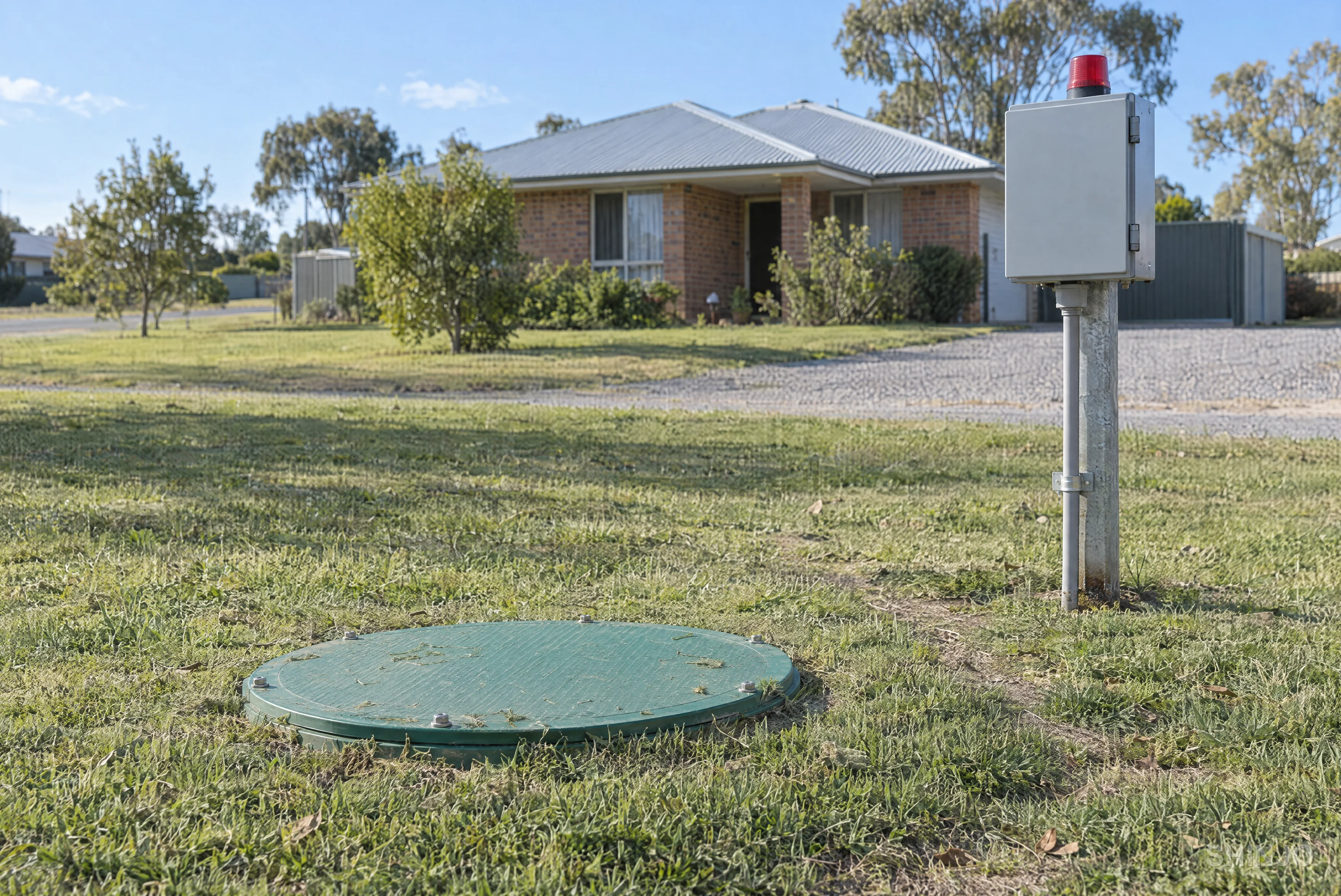
EPA's pressure-sewer fact sheet (832-F-02-006, 2002) names two major types, septic tank effluent pump (STEP) and grinder pump (GP), and neither requires changes to the plumbing inside the house (U.S. Environmental Protection Agency, 2002). In a STEP system, wastewater enters a septic tank and the liquid effluent flows to a holding tank with a pump and controls (U.S. Environmental Protection Agency, 2002). With the solids left in the tank, that unit does the work of an effluent pump rather than a sewage pump (U.S. Environmental Protection Agency, 2002).
In a GP system, sewage flows to a vault where a grinder pump grinds the solids and discharges into the pressurized pipe; GP needs no septic tank but may need more horsepower (U.S. Environmental Protection Agency, 2002). Grinding lets raw sewage travel through small pipe; a standard sewage pump passes solids whole (Rook, n.d.).
EPA sizes centrifugal grinder pump systems with Q = 20 + 0.5D (Q in gpm, D the number of homes served) and no allowance for infiltration or inflow (U.S. Environmental Protection Agency, 2002). For 50 homes, Q = 20 + 0.5 x 50 = 45 gpm (2.8 L/s). No minimum velocity is generally used, but a GP system must reach 0.9-1.5 m/s (3-5 ft/s) at least once a day (U.S. Environmental Protection Agency, 2002). EPA suggests a Hazen-Williams C of 130-140, and mains are generally 50 mm (2 in) or larger PVC (SDR 21) (U.S. Environmental Protection Agency, 2002).
Pressure sewers are most cost-effective, per EPA's 2002 fact sheet, where housing density is low, where terrain undulates with relatively high relief, and where the outfall sits at or above the elevation of most of the service area (U.S. Environmental Protection Agency, 2002). Flat ground with high groundwater or bedrock qualifies too, where deep cuts or multiple lift stations would be too expensive (U.S. Environmental Protection Agency, 2002).
Difficult construction or right-of-way conditions qualify as well (U.S. Environmental Protection Agency, 2002). The watertight, manhole-free design also eliminates extraneous flows (U.S. Environmental Protection Agency, 2002).
The trade-off is operational. EPA's listed disadvantages include much institutional involvement, operating and maintenance costs often above gravity's (lift stations in a gravity sewer can reverse that), STEP tank pump-out every 2-3 years and a limited number of pumps per shared force main (U.S. Environmental Protection Agency, 2002). Without standby generators, power outages can cause overflows, and the usually septic wastewater brings odors and corrosion (U.S. Environmental Protection Agency, 2002). EPA estimates the mean time between service calls at 4 to 10 years for quality GP and STEP installations, though data vary greatly (U.S. Environmental Protection Agency, 2002).
A single building below the sewer gets a sewage pump in a basin; a district matching EPA's conditions should compare a pressure sewer with gravity on cost.
The 2014 edition of the Recommended Standards for Wastewater Facilities (Ten States Standards), section 44.1, asks for submersible pumps and motors designed specifically for raw wastewater, including totally submerged operation during part of each cycle, and for an effective method to detect shaft seal failure or potential seal failure (Great Lakes-Upper Mississippi River Board, 2014).
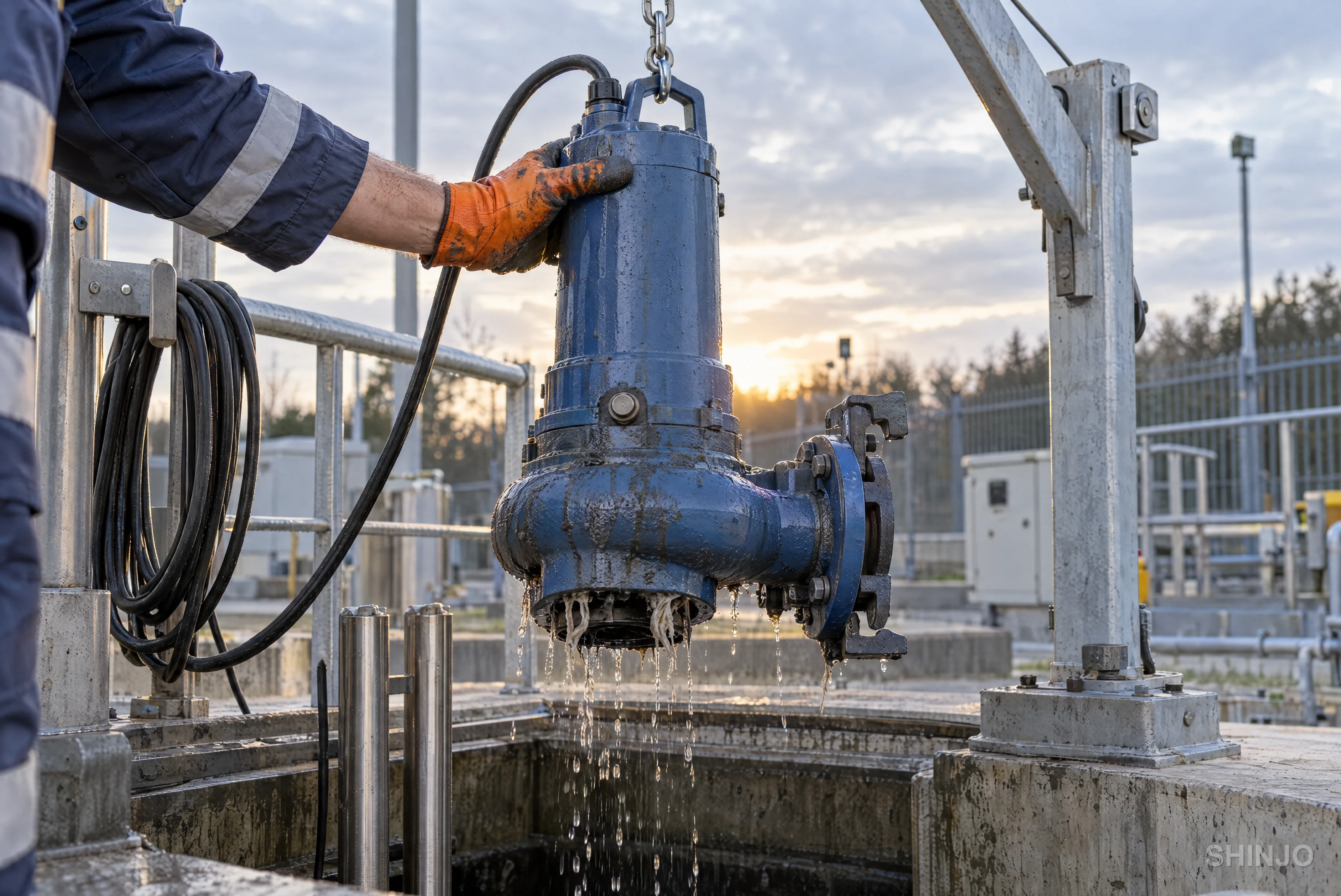
Section 44.2 of the same edition adds that submersible pumps be readily removable and replaceable without personnel entering or dewatering the wet well or disconnecting any piping in it (Great Lakes-Upper Mississippi River Board, 2014). Under any catalog name (submersible sewage pump, submersible waste pump), the motor must survive immersion and the operator must hear about a failing seal before the winding does.
Goulds (Xylem) lists tandem mechanical seals in an oil-filled chamber, each operating independently (Xylem, 2025). Dual moisture-sensing probes in the oil between the inner and outer seals detect moisture before it reaches the bearings or stator (Xylem, 2025). Two automatic-reset thermostats sit on the windings (Xylem, 2025). KSB fits temperature and moisture sensors as standard on its Amarex KRT with cooling jacket. Shinjo's JYWQ page lists a double-end mechanical seal running in an oil chamber.
A second seal buys time. The probe turns that time into the warning the 2014 edition asks for. On any pump offered, ask where each sensor sits and what signal reaches the control panel.
Per Wilo, a surface-cooled motor sheds heat into the surrounding liquid and needs full submergence. KSB's Amarex KRT with cooling jacket stays fully operational when not submerged, so it can run at low sump levels or installed dry; a closed water-glycol circuit cools the motor. Shinjo states the JYWQ's internal circulation cooling system lets it work at the lowest pool level, with a working temperature up to 60 °C (140 °F). KSB also notes that the IEC standard behind IE efficiency classes is not binding for submersible motors.
IP68 alone states no depth or duration. An IP rating has two digits: the first for protection against solids, the second for protection against liquids. In IEC 60529, numeral 8 means continuous immersion. As the test lab Applus+ Keystone quotes the standard, unless a product standard applies, the test conditions are agreed between manufacturer and user and must be more severe than IPX7. IPX7, as Element summarizes it, is immersion between 15 cm and 1 m (about 6 in and 3.3 ft) for up to 30 minutes. A datasheet claiming IP68 should declare both the depth and the duration.
Where the wet well is a classified hazardous location, the pump motor has to suit that classification. Goulds' 3SDX, for example, carries an explosion-proof motor rated Class 1, Division 1, Groups C and D (Xylem, 2025). The rating covers that listed model; the certificate should name the exact model offered.
Gray cast iron is the base material in both Goulds' and KSB's literature. Goulds specifies Class 30 gray cast iron (ASTM A48) for casing and impeller (Xylem, 2025); a KSB newsletter lists the Amarex KRT in gray cast iron, with duplex stainless steel (which KSB calls corrosion-resistant) or white cast iron (wear-resistant) as options. Neither label settles whether a material suits a particular sewage. Send the liquid temperature, pH and any industrial inflow, and ask the supplier to confirm the material.
The National Association of Clean Water Agencies (NACWA) estimated in September 2020 that wipes add about $441 million a year to the collection-system operating costs of US clean-water utilities, from 2019 data on 25 utilities in 19 states. Because it counts only those costs, NACWA calls the estimate conservative (National Association of Clean Water Agencies, 2020).
UK Water Industry Research found that wet wipes contribute to 94% of UK sewer blockages, which cost water companies around £200 million a year to fix, DEFRA reported in 2025 (Department for Environment, Food & Rural Affairs, 2025). In functional performance tests reported in 2021 by Beck and colleagues, wastewater pumps reacted very differently to clogging: some lost hydraulic function, while in others performance stayed almost constant, or rose in some cases, but with an increased power requirement (Beck et al., 2021). A 2019 ASME conference paper by Mitchell and colleagues found that wipes labeled "flushable" differed in clogging effect depending on whether they met industry flushability guidelines (Mitchell et al., 2019). The fix for a sewage pump is upstream: keep wipes, "flushable" or not, out of the sewer.
A Goulds (Xylem) presentation to the National Onsite Wastewater Recycling Association (NOWRA) on wastewater pump basics warns that, in a pump basin, a bottom-intake sewage pump can air-lock and not pump although its impeller turns (Rook, n.d.). The presentation calls for a 4.8 mm (3/16 in) relief hole in the discharge pipe inside the wet well, 51 mm (2 in) above the pump discharge and below the check valve (Rook, n.d.). Without a working check valve, backflow can spin the pump backwards (Rook, n.d.). On force mains, the 2014 edition of the Ten States Standards (section 49.2) calls for air relief valves at high points to prevent air locking (Great Lakes-Upper Mississippi River Board, 2014).
Short cycling means too many starts, and Flygt's design guidance ties starts per hour to pump life. The same Goulds presentation sets minimum run times of 1 minute for motors up to 1.1 kW (1-1/2 hp) and 2 minutes from 1.5 kW (2 hp) up (Rook, n.d.). More active volume between the start and stop levels, sized to the pump maker's starts-per-hour limit, cures short cycling.
Summit Pump's 2020 newsletter states that most centrifugal pumps cannot pump liquids with more than 10% entrained air, and almost never much above 14%. Causes it lists include inflow dropping from height near the suction and shallow sumps with too little submergence, and the sump design has to avoid both.
EPA's 2000 lift-station fact sheet calls weekly inspections typical: pumps, motors and drives checked for unusual noise, vibration, heating and leakage, plus valves, control-panel switch positions, and discharge rates and pressures (U.S. Environmental Protection Agency, 2000). Log motor current as well, to catch a pump that clogs but keeps pumping.
Suppliers quote the sewage pump they are asked for. When you compare sewage pumps for sale, send each bidder the same written list so the offers line up point for point.
| Item | What to state | Why it matters |
|---|---|---|
| Duty point | Flow at TDH at the low and the high wet-well level | Static head differs between the levels |
| Solids passage | Largest sphere passed, in mm | Outlet size is a different figure |
| Installation | Guide-rail wet pit, jacketed dry pit, self-priming or transfer duty | Sets mounting and motor cooling |
| Liquid | Temperature and pH | Limits materials and seals |
| Power supply | Voltage, phase, 50 or 60 Hz | Motor and curve follow the supply |
| Starts per hour | Design figure for the controls | The pump maker sets the limit (Great Lakes-Upper Mississippi River Board, 2014) |
| Seals and sensors | Seal arrangement, leak and temperature sensing | Detects a leaking seal before water reaches the motor (Xylem, 2025) |
| Cable and area | Cable length; hazardous-area requirement | Raw-sewage wet wells can be hazardous locations (Great Lakes-Upper Mississippi River Board, 2014) |
| Materials | Casing, impeller, shaft | Corrosion and wear life |
| Tests and documents | Test standard and grade; curves and documents | Makes the offer checkable |
The 2014 edition of the Recommended Standards for Wastewater Facilities (Ten States Standards), section 42.31, states all pumps should be tested by the manufacturer, including a hydrostatic test and an operating test (Great Lakes-Upper Mississippi River Board, 2014). An inquiry that names the hydraulic test standard and grade, such as ANSI/HI 14.6-2022 or ISO 9906:2012, turns that advice into a contract term.
For a submersible, name both standards: the 2022 edition of the Hydraulic Institute's ANSI/HI 11.6 covers only electrical and mechanical integrity testing, and hydraulic performance and hydrostatic pressure tests moved to ANSI/HI 14.6-2022. For a new wet well, ask that the intake follow ANSI/HI 9.8-2024.
In Shinjo's sewage pump range, the WQ specification table lists per model the impeller passage in mm beside outlet size, guide-rail fitting, maximum flow and head, speed and motor power. Its passages run from 20 mm on some 2 in outlet models to 80 mm on the 12 in outlet models. Compare offers on the passage figure, because outlet size does not tell you what solids a pump will pass.
What is a sewage pump used for? It moves raw sewage and untreated wastewater, solids included. KSB names municipal treatment plants as the main use, plus buildings and private homes that cannot drain to the sewer by gravity (KSB, n.d.). Typical examples are a basement ejector serving fixtures below the sewer and the duty pumps in a municipal lift station.
How much does a sewage pump cost? There is no single price; cost follows the specification. Drivers include size, solids passage, materials, motor power and voltage, seals and sensors, any hazardous-area rating, controls and testing. A lift station adds civil works, and EPA names design capacity and installed pump power as its most important construction-cost factors (U.S. Environmental Protection Agency, 2000).
Will a sewage pump handle toilet paper? Yes. EPA's septic-care rule of thumb is to flush nothing besides human waste and toilet paper (U.S. Environmental Protection Agency, n.d.). Wipes are the problem: nonwoven wipes do not disintegrate the way toilet paper does and can clog pumps (Mitchell et al., 2017), and UK government advice is to bin them, even those labeled flushable (Department for Environment, Food & Rural Affairs, 2025).
Is a sewage pump the same as a septic system? No. A septic system treats and disperses wastewater on site; EPA describes a typical one as a septic tank, where solids settle as sludge, plus a drainfield that takes the liquid effluent (U.S. Environmental Protection Agency, 2026). The pump is a lifting device that may discharge into a septic tank or a sewer.
Can you use a sump pump as a sewage pump? No. SSPMA classes, as Goulds presents them, rate sump pumps for clear water with solids up to 1/2 in (13 mm) (Rook, n.d.). The 2025 Plumbing Code of New York State, derived from the 2024 International Plumbing Code, requires pumps receiving toilet discharge to pass 2 in (51 mm) spheres (International Code Council & New York State Department of State, 2025).
How do you know if your sewage pump is bad? Signs include a high-level alarm, a pump that runs continuously or will not start, and sewage odor. EPA's typical weekly lift-station checks look for unusual noise, vibration, heating and leakage (U.S. Environmental Protection Agency, 2000). Watch motor current too: in functional performance tests, some clogging pumps kept almost constant head while needing more power (Beck et al., 2021).
What is the difference between a sewage pump and a grinder pump? A grinder pump cuts solids before pumping them; a sewage pump passes them uncut. Cutting lets a grinder make a high-head discharge through small pipe, but it needs maintenance and overhauls (Rook, n.d.). Grinders serve one of the two major pressure-sewer types EPA describes, pumping into pressurized pipe (U.S. Environmental Protection Agency, 2002).
What type of pump is used for sewage? A centrifugal pump designed not to clog. EPA states that centrifugal pumps are commonly used in lift stations (U.S. Environmental Protection Agency, 2000). The 2014 edition of the Ten States Standards (§42.33) asks raw-wastewater pumps to pass 80 mm (3 in) spheres (Great Lakes-Upper Mississippi River Board, 2014). Pressure sewers use grinder pumps or septic tank effluent pump (STEP) units (U.S. Environmental Protection Agency, 2002).
A sewage pump is defined by the solid it can pass, so fix that figure first. Flow and head come second, and they only make sense inside a station.
That station is the system. Firm capacity carries peak hourly flow with any one pump out of service. Valves, level controls, alarms and wet-well ventilation keep it running and safe to service. Sizing runs from peak flow to total dynamic head to wet-well volume, using the pump maker's own starts-per-hour limit. Where deep gravity cuts or extra lift stations cost too much, a pressure sewer can replace gravity pipe.
Seal-leak detection and motor temperature sensors, plus a cooling jacket wherever the motor may run uncovered, keep a submersible alive. Wipes, not toilet paper, are what clog the pump.
A datasheet should show solids passage in mm, the duty point at low and high wet-well levels, allowed starts per hour, the seal arrangement and the declared IP68 immersion conditions. A quote should show the pump count behind firm capacity and the edition of the standard the design follows.
- Great Lakes-Upper Mississippi River Board of State and Provincial Public Health and Environmental Managers. (2014). Recommended standards for wastewater facilities (2014 ed.). Health Research, Inc., Health Education Services Division. https://www.health.state.mn.us/communities/environment/water/docs/tenstates/tenstatestan2014.pdf
- U.S. Environmental Protection Agency. (2000). Collection systems technology fact sheet: Sewers, lift station (EPA 832-F-00-073). https://nepis.epa.gov/Exe/ZyPURL.cgi?Dockey=901U0X00.TXT
- U.S. Environmental Protection Agency. (2002). Wastewater technology fact sheet: Sewers, pressure (EPA 832-F-02-006). https://www.epa.gov/sites/default/files/2015-06/documents/presewer.pdf
- U.S. Environmental Protection Agency. (2026, June 10). How septic systems work. https://www.epa.gov/septic/how-septic-systems-work
- U.S. Environmental Protection Agency. (n.d.). How to care for your septic system. https://www.epa.gov/septic/how-care-your-septic-system
- International Code Council & New York State Department of State. (2025). 2025 Plumbing Code of New York State. https://dos.ny.gov/system/files/documents/2025/07/2025pcnys_noa_2025-07-24.pdf
- Rook, J. (n.d.). Wastewater pumps: Basics, sizing, rules of thumb [Conference presentation]. National Onsite Wastewater Recycling Association. https://www.nowra.org/Customer-Content/www/CMS/files/24Mega_Rook_Pumps.pdf
- Xylem. (2025). Wastewater product catalog (WWS R20). https://www.xylem.com/siteassets/brand/goulds-water-technology/resources/brochure/wastewater-product-catalog-wws.pdf
- KSB SE & Co. KGaA. (n.d.). Sewage pump. In KSB centrifugal pump lexicon. https://www.ksb.com/en-global/centrifugal-pump-lexicon/article/sewage-pump-1117348
- National Association of Clean Water Agencies. (2020). The cost of wipes on America's clean water utilities [Executive summary]. https://www.nacwa.org/docs/default-source/resources---public/executive-summary_cost_of_wipes.pdf
- Department for Environment, Food & Rural Affairs. (2025, November 18). New law bans plastic wet wipes to protect rivers and seas [Press release]. GOV.UK. https://www.gov.uk/government/news/new-law-bans-plastic-wet-wipes-to-protect-rivers-and-seas
- Beck, D., Holzbauer, Y., & Thamsen, P. U. (2021). Different clogging behavior of wastewater pumps. In Proceedings of the ASME 2021 Fluids Engineering Division Summer Meeting: Vol. 2. Fluid applications and systems; fluid measurement and instrumentation (Article V002T03A027). American Society of Mechanical Engineers. https://doi.org/10.1115/FEDSM2021-65422
- Mitchell, R.-L., Busche, S., & Thamsen, P. U. (2019). Investigations into wet wipe related clogging phenomena of wastewater pumps. In Proceedings of the ASME-JSME-KSME 2019 8th Joint Fluids Engineering Conference: Vol. 3B. Fluid applications and systems (Article V03BT03A038). American Society of Mechanical Engineers. https://doi.org/10.1115/AJKFluids2019-5446
- Mitchell, R.-L., Thamsen, P. U., Gunkel, M., & Waschnewski, J. (2017). Investigations into wastewater composition focusing on nonwoven wet wipes. Czasopismo Techniczne, 1, 125-135. https://doi.org/10.4467/2353737XCT.17.010.6107
- Guimarães, F. D., Oliveira, N. S., Vaz, M. M., & Formiga, K. T. M. (2026). Optimised operation of sewage pumping stations: A systematic review. Results in Engineering, 30, Article 110798. https://doi.org/10.1016/j.rineng.2026.110798
Last reviewed and updated: October 2026. Author: Shinjo Pump engineering team. For pump selection support or a quotation on your duty point, contact our team.
