Choose a PTFE-lined pump when the liquid attacks stainless steel: hydrochloric acid, hydrofluoric acid, dilute sulfuric acid, aqua regia, mixed acids and strong oxidizers. Choose a stainless steel pump when the liquid stays within the resistance of the grade and the duty is hotter, higher in head or pressure, or carries solids. In Shinjo's range, that means the IHF lined centrifugal pump (up to 80 °C and 87 m) or the sealless CQB-F on one side, and the IH stainless steel chemical pump (up to 150 °C, 132 m and 1.6 MPa) on the other.
Start with the liquid. For many common chemicals, one of the two options is ruled out before flow and head are even considered.
| Liquid | Stainless steel pump | PTFE-lined pump | Usual choice |
|---|---|---|---|
| Hydrochloric acid, any strength | Not resistant: 304 and 316 are attacked at any concentration | Resistant | Lined |
| Hydrofluoric acid | Attacked | Resistant | Lined |
| Sulfuric acid, 5–80% | Attacked; 316 is only usable below about 5% or above 95% at low temperature | Resistant | Lined |
| Nitric acid | 304L and 316L are widely used | Resistant | Either; stainless steel for higher temperature or head |
| Sodium hydroxide | Suitable at moderate temperature | Resistant | Either |
| Brine and seawater | 316L is limited to about 1,000 ppm chloride | Resistant | Lined, or duplex steel for high head or solids |
| Organic solvents and oils | Usually suitable | Usually resistant, but some solvents permeate fluoroplastics | Stainless steel |
| Liquids with hard or abrasive solids | Suitable grades tolerate moderate solids | Hard particles cut the lining | Stainless or duplex steel |
| Any liquid above 80 °C | IH pump is rated to 150 °C | Above the published rating | Stainless steel or alloy |
For 98% sulfuric acid, where cast iron is also an option, see our guide to the concentrated sulfuric acid pump.
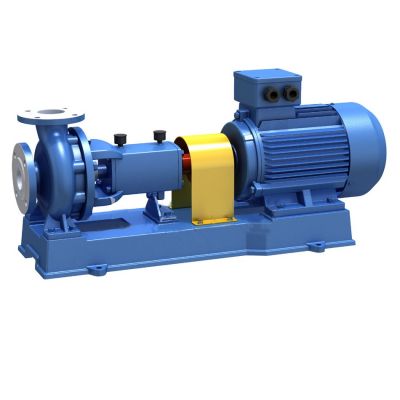
In the pump trade, "PTFE-lined" and "Teflon-lined" usually mean any fluoroplastic lining: PTFE, FEP (also called F46) or PFA. PTFE cannot be melt-processed, so molded pump linings are usually FEP or PFA, which flow when heated. The IHF is lined with FEP. Its impeller and pump cover are metal inserts with fluoroplastic sintered over them.
The metal casing carries the pressure and the pipe loads, and the lining resists the chemicals. This is why a lined pump can handle hydrochloric acid, hydrofluoric acid, aqua regia, strong alkalis, strong oxidizers and most organic solvents. These are all listed on the IHF product page. Doing the same with solid metal would mean a far more expensive nickel alloy casing.
The fluoroplastics themselves tolerate high temperatures: PFA is rated for continuous service up to 260 °C. The pump's limit is much lower because the lining is locked into a steel casing, and plastic expands many times more than steel when heated. Heat and rapid temperature changes stress the bond between the two. That is why the published liquid temperature for the IHF and CQB-F is 80 °C.
The IHF uses an external bellows mechanical seal, so the springs and metal parts of the seal sit outside the liquid. The stationary face is 99.9% alumina ceramic or silicon carbide, and the rotating face is filled PTFE or silicon carbide.
Stainless steel resists corrosion because of a thin chromium oxide film. Anything that breaks that film down faster than it can reform will corrode the pump, and some chemicals do this from the first day.
- Hydrochloric acid. Standard 304 and 316 are considered non-resistant at any concentration and temperature.
- Chlorides. A widely used guideline for immersed stainless steel puts the chloride limit at about 200 ppm for 304L, 1,000 ppm for 316L and 3,600 ppm for duplex 2205. Above that, pitting and crevice corrosion start. Crevices, deposits and heat lower these limits.
- Hot chlorides. Chloride stress corrosion cracking of 304 and 316 is rare below 60 °C but becomes a real risk above it. Duplex grades resist it much better.
- Dilute reducing acids. Sulfuric acid between about 5% and 80% attacks 316 actively.
The grade matters as much as the word "stainless". The IH pump and the CQ magnetic drive pump are offered in 304, 316 and 316L. For flue gas desulfurization slurry, which combines chlorides, acidity and abrasion, the cast steel desulfurization pump uses a duplex ("two-phase") alloy for the casing and impeller.
A lining resists chemicals well. It fails mechanically and thermally, and these failures usually come from operating conditions rather than from the chemical itself.
- Heat and thermal cycling. Running near the top of the range, or heating and cooling the pump quickly, can blister the lining or separate it from the casing. Steam cleaning is a common cause, because steam is well above 80 °C.
- Vacuum. If the suction can fall below atmospheric pressure, for example when a line drains or siphons, the lining can be pulled away from the casing. Tell the supplier if vacuum is possible.
- Solids and cavitation. Hard or sharp particles cut and wear the lining, and collapsing cavitation bubbles erode it. Once the metal behind it is exposed, it corrodes quickly.
- Permeation. Small molecules such as hydrogen chloride, chlorine and bromine slowly diffuse through fluoroplastics. They can condense behind the lining and cause blisters. A thicker lining slows this down.
- Mechanical damage. Pipe strain, overtightened flanges and careless tools during maintenance all crack linings.
Lined pumps also reach lower heads. The IHF goes up to 87 m and the CQB-F up to 32 m, while the IH stainless steel pump reaches 132 m.
- Steam-out or hot cleaning above the 80 °C rating.
- Vacuum in the suction when the system drains or siphons.
- Hard solids or cavitation that cut through the lining.
- Dry running, especially in a lined magnetic drive pump whose bearings are cooled by the liquid.
- Sudden temperature changes such as hot acid entering a cold pump.
| Pump | Construction | Flow | Head | Liquid temperature | Shaft sealing |
|---|---|---|---|---|---|
| IHF | Metal casing lined with FEP | 3–130 m³/h | 5–87 m | Up to 80 °C | External bellows mechanical seal |
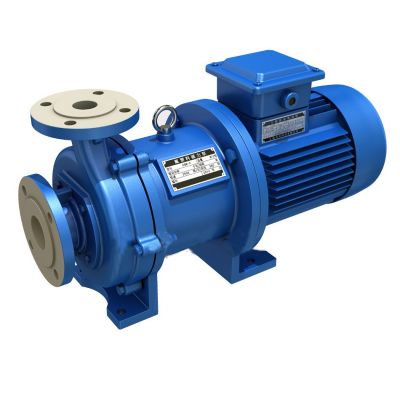
| CQB-F | Metal casing with fluoroplastic lining, magnetic drive | 1.8–100 m³/h | 8–32 m | Up to 80 °C | None (sealless) |
| IH | Stainless steel, back pull-out design | 3.2–400 m³/h | 5–132 m | −20 to 150 °C | Mechanical seal |
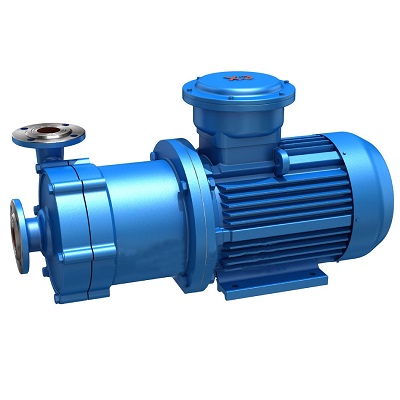
| CQ | Stainless steel 304, 316 or 316L, magnetic drive | Up to 60 m³/h | 5–50 m | Up to 80 °C, 200 °C on request | None (sealless) |
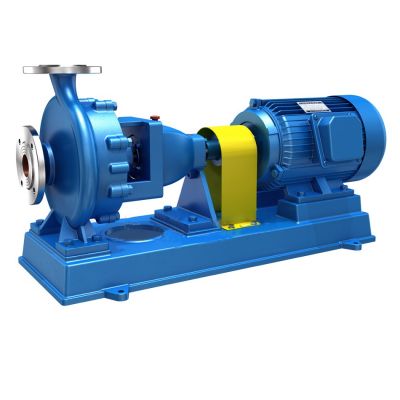
The IH has a back pull-out design. The rotating assembly comes out after removing the coupling spacer, without disturbing the casing, piping or motor. That shortens maintenance on a pump that sees regular seal changes.
The casing material is only half the decision. If a leak would be dangerous, toxic or costly, choose a magnetic drive pump with no shaft seal: the CQB-F for liquids that need a lining, or the CQ for liquids stainless steel can handle. For cool, mildly corrosive liquids, the CQF polypropylene magnetic drive pump is a lower-cost option up to 60 °C.
Magnetic drive pumps have their own limits. Their internal bearings are lubricated by the pumped liquid, so they must never run dry, and they need a clean liquid. For more on sizing them, see how to select a magnetic drive pump.
For hydrochloric acid, the real comparison is not lined pump against 316, because 316 fails. It is lined pump against a nickel alloy such as Hastelloy, and the lined pump is usually much cheaper. For a liquid that stainless steel handles well, a stainless pump avoids every lining risk above and tolerates upsets, solids and hot cleaning. In that case, the lining adds cost without adding life.
Count the failures, not just the purchase price. A lined pump that blisters after every steam-out costs more than a stainless pump in the right grade. A 316 pump that pits through in brine costs more than a lined pump that would have lasted.
- The liquid and its concentration range, including trace chlorides or fluorides.
- Normal and maximum temperature, and any steam or hot-water cleaning.
- Flow, head and suction conditions, including whether vacuum is possible.
- Solids content, particle size and hardness.
- Whether a leak is acceptable, which decides between a sealed and a sealless pump.
- Operating pattern: continuous, batch or frequent starts.
Not sure whether your liquid needs a lining? Send the details to SHINJO and we will recommend a pump and material for your duty. Our full range is in the chemical process pumps category.
Yes. Teflon is a brand name for PTFE and related fluoroplastics. In practice, "PTFE-lined" and "Teflon-lined" pumps are often lined with FEP or PFA, which can be molded. The IHF is lined with FEP (F46).
Yes. Fluoroplastic linings resist hydrochloric acid at all concentrations within the pump's temperature rating, while 304 and 316 stainless steel do not. Over time, hydrogen chloride can permeate the lining, so avoid running at the top of the temperature range.
The limit protects the bond between the lining and the steel casing. Plastic expands many times more than steel, so heat and rapid temperature changes can blister or loosen the lining long before the plastic itself degrades.
Usually not. A common guideline limits 316L to about 1,000 ppm chloride, and seawater contains about 19,000 ppm. Use a lined pump, a duplex or super duplex steel, or a plastic pump for seawater and strong brines.
Only fine, soft solids in low concentration. Hard or sharp particles cut and wear the lining. For corrosive slurries, a duplex steel pump such as the desulfurization pump is usually the better choice.
